
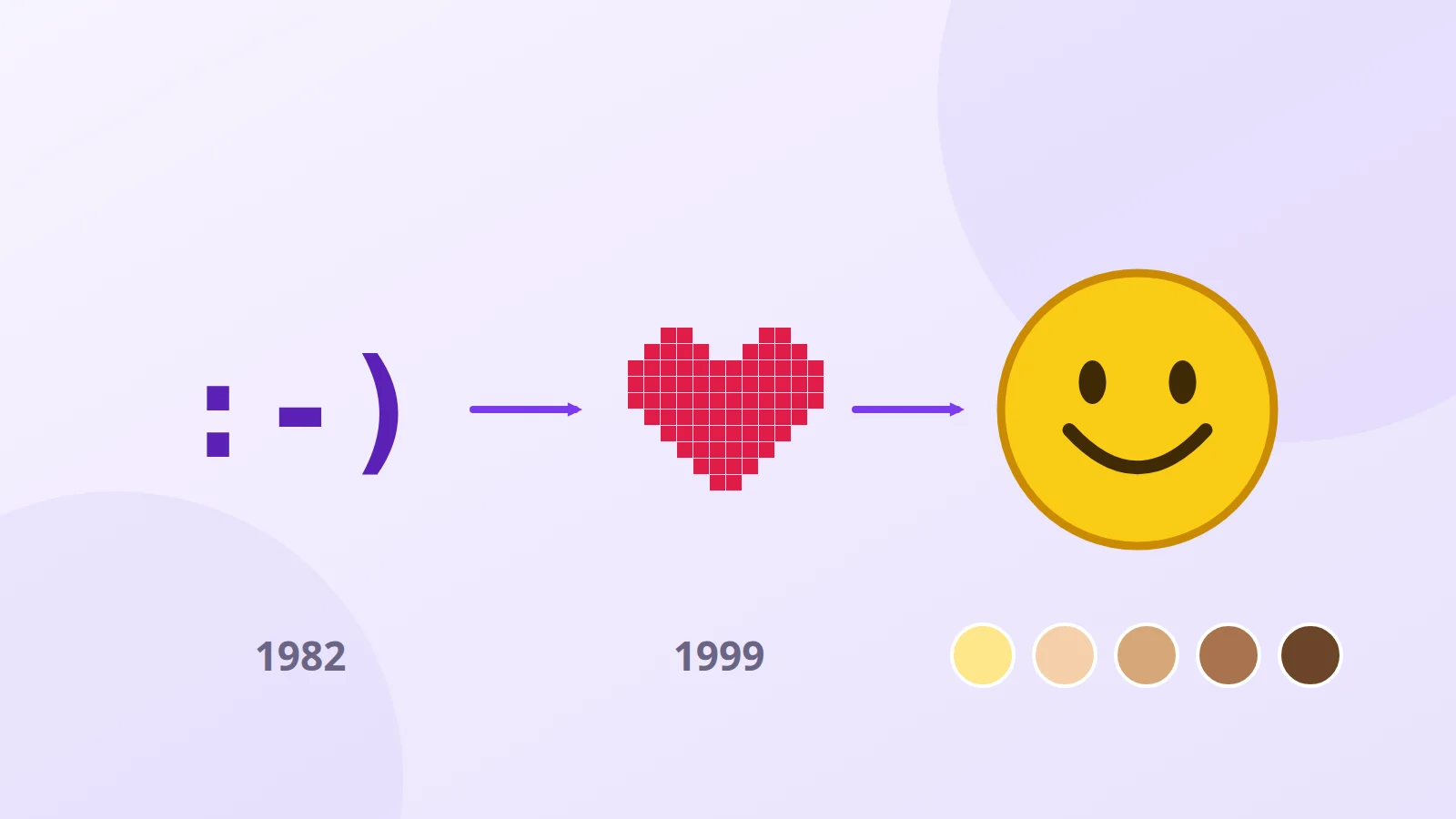
Emoji are everywhere: in messages, emails, even domain names. In 2015, Oxford Dictionaries chose 😂 as its "word of the year". Yet their story starts with three punctuation marks.
1982: the first smiley
On 19 September 1982, Scott Fahlman, a computer scientist at Carnegie Mellon University, suggested on an internal message board using :-) to mark a joke and :-( for things that were serious. The message became famous:
"I propose that the following character sequence for joke markers: :-)"
These emoticons, read with your head tilted, spread across the Internet and then into text messages. In Japan, people preferred kaomoji, read upright: (^_^).
1999: Japanese emoji
The word comes from Japanese e (picture) and moji (character). It has nothing to do with "emotion".
In 1999, the operator NTT DoCoMo launched i-mode, one of the first mobile Internet services. A team member, Shigetaka Kurita, drew a set of 176 small images, 12 × 12 pixels each: sun, umbrella, heart, phone, weather symbols… They packed a lot of information onto tiny screens.
They were an instant hit, and other Japanese carriers created their own emoji. The problem: they weren't compatible, so an emoji sent from one network to another could show up as an empty box.
Kurita's original set is now part of the collection of MoMA, the Museum of Modern Art in New York.
2010: emoji join Unicode
When Apple and then Google wanted to offer emoji outside Japan, a common standard was needed. In 2010, the Unicode Consortium, the body that gives a number to every character in every script, added several hundred emoji.
Each one gets a code, just like a letter: U+1F600 for 😀, U+2764 for ❤. That way every device knows which emoji is meant. But each manufacturer draws its own, which is why the same emoji can look different on an iPhone and an Android phone. The pistol 🔫, for instance, became a water pistol at Apple in 2016, and later at Google and others.
Who decides on new emoji?
Anyone can propose an emoji to the Unicode Consortium, but the proposal has to make a case: it must show the emoji will be widely used, that it doesn't already exist in another form, and that it isn't a brand logo or a real person. A few dozen new emoji are accepted each year.
Several changes have made emoji more representative:
- skin tones, added in 2015 in five shades: 👍🏻 👍🏼 👍🏽 👍🏾 👍🏿;
- male, female and gender-neutral versions of most jobs and activities;
- objects and food from around the world: 🧉 mate, 🥟 dumpling, 🧕 woman with headscarf, 🛕 Hindu temple.
How to type emoji on a computer
- Windows 10 and 11: Windows + . (full stop) or Windows + ; opens the emoji panel. Type a word to search, such as "cat".
- macOS: Control + Command + Space opens the Character Viewer, with a search bar.
- Linux: depending on your desktop, an emoji picker is often built in (in GNOME, right-click in a text field).
- On the web: our emoji to copy and paste page groups them by category; one click copies an emoji.
Mind the context
What an emoji means depends on who's using it. 🍆 and 🍑 have taken on a meaning their creators never intended. For younger users, 💀 often means "I'm dead (laughing)" rather than "dead", and 🙂 can come across as cold or sarcastic. In a work message, stick to the most neutral ones.
Further reading
- ASCII and Unicode: how computers encode characters
- Understanding Japanese input
- Emojipedia, the emoji encyclopedia
- MoMA: Shigetaka Kurita's original emoji