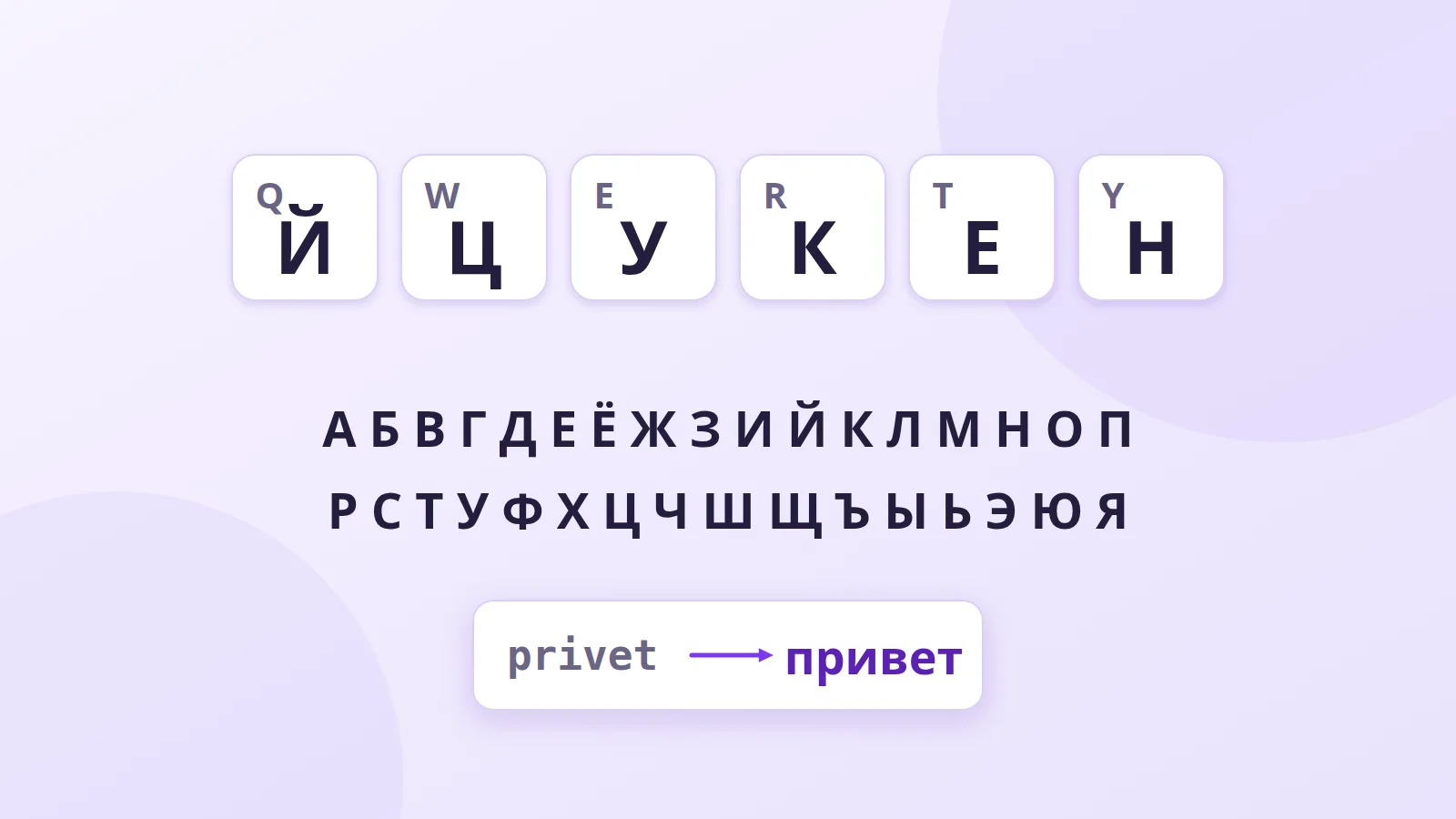
The Cyrillic alphabet looks intimidating at first, but it's quick to learn: within a few days you can read it slowly, and within a few weeks fluently. Typing Russian takes a bit more work, because the Russian keyboard doesn't follow the order of Latin letters. Here's how to go about it.
The 33 letters, grouped by difficulty
Modern Russian has 33 letters. Cyrillic largely descends from the Greek alphabet, as the Latin alphabet does, which is why many shapes look familiar.
Letters that sound the way they look
- А as in "father"
- К as in "kite"
- М as in "mum"
- О as in "more" (when unstressed it sounds closer to "a")
- Т as in "top"
False friends
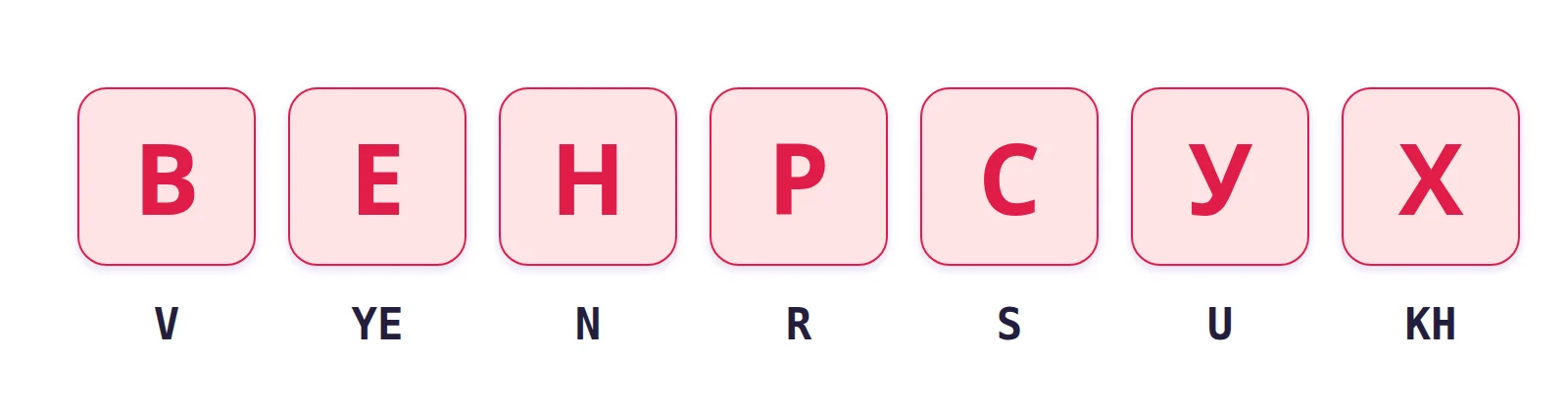
These look like Latin letters but sound different. They cause most mistakes at the start.
- В is a v, as in "van".
- Е is ye, as in "yes".
- Н is an n.
- Р is a rolled r.
- С is always an s, as in "sun".
- У is oo, as in "food".
- Х is a throaty sound, like the "ch" in Scottish "loch".
For example, the old abbreviation СССР reads "SSSR".
Letters from Greek
- Г (gamma): a hard g, as in "go".
- Д (delta): d.
- Л (lambda): l.
- П (pi): p.
- Ф (phi): f.
- З looks like a 3 and sounds like z.
Letters unique to Cyrillic
- Б: b, not to be confused with В.
- И: ee, as in "see".
- Й: a short y, as in "boy".
- Ж: like the s in "pleasure".
- Ц: ts, as in "cats".
- Ч: ch, as in "chair".
- Ш: sh, as in "shop".
- Щ: a longer, softer sh.
- Ы: a sound between "i" and "oo", with no English equivalent.
- Э: e, as in "met".
- Ю: yu, as in "you".
- Я: ya, as in "yard".
The two signs
- ь (soft sign) isn't pronounced: it softens the consonant before it.
- ъ (hard sign) is rare and marks a slight break.
The standard Russian keyboard: ЙЦУКЕН
The keyboard used in Russia is called ЙЦУКЕН, after the first six letters at the top left. It has nothing to do with pronunciation: it's organised by how often letters are used in Russian. The most common ones (О, А, Е, И, Н, Т, Р, С) are in the centre, under the index and middle fingers.
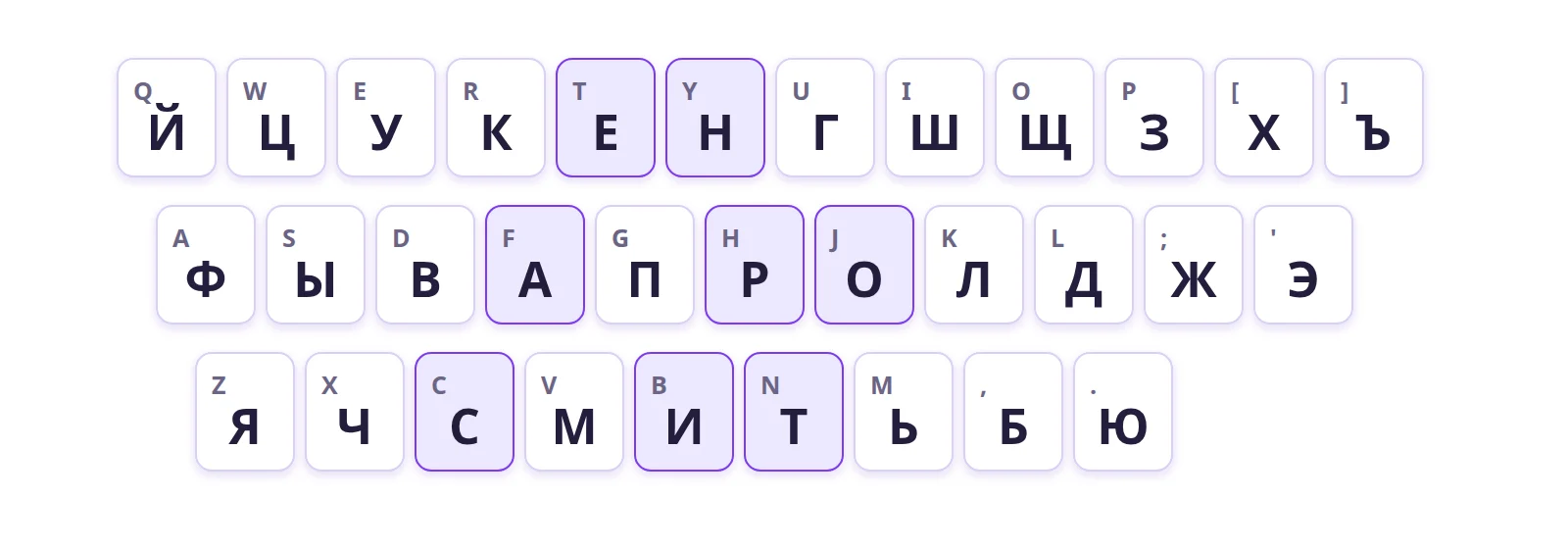
For an English speaker, everything has to be relearned: А is on the F key, О on J, В on D. But it's the layout to learn if you plan to write a lot of Russian or use computers in Russia.
The phonetic keyboard
The alternative is to put each Russian letter on the Latin letter that sounds the same: А on A, К on K, М on M. Letters with no equivalent go on a key that's close in sound or shape (Ш on W, Я on Q, for example). There are several variants, and they don't always agree.
The upside: you can type straight away without looking at your hands. The downside: it isn't a standard, and you'll be lost on an ordinary Russian keyboard.
Tools for practising
Our Russian keyboard
Our Russian keyboard shows the ЙЦУКЕН layout on screen. You can click the letters, or type on your own keyboard to learn where they are.
It also has a transliteration mode: you type Russian in Latin letters and it converts them. privet gives привет, and letter combinations work too: zh gives ж, ch gives ч, sh gives ш, shch gives щ, ya gives я, yu gives ю.
Installing Russian on your computer
- Windows: add "Russian" in Settings > Time & language > Language & region. In the keyboard options you can add "Russian – Mnemonic", a phonetic variant.
- macOS: System Settings > Keyboard > Input Sources. Choose "Russian – PC" for ЙЦУКЕН or "Russian – Phonetic".
If you're learning ЙЦУКЕН, Cyrillic stickers on your keys help a lot in the first few weeks.
A four-step method
- Read, without a keyboard (one week). Decipher street signs on Google Street View in Moscow and brand names: ПУМА, МАКДОНАЛДС.
- Write by hand. Russians write in cursive, where some letters change a lot: lower-case т looks like an m, д like a g. Handwriting helps you memorise the letters.
- Type phonetically. With transliteration mode, you can write Russian from day one without fighting the keyboard.
- Move to ЙЦУКЕН. If you're aiming for a good level or a stay in Russia, learn the standard layout, ten minutes a day, starting with the middle row: ФЫВА ПРОЛДЖ. Free software such as Stamina or Klavaro will guide your practice. After a few weeks you'll type faster than phonetically.
Удачи! (Good luck!)
Further reading
- Our keyboards: Russian, Ukrainian, Bulgarian, Serbian
- Accents and diacritics around the world
- The history of the keyboard
- Cyrillic script (Wikipedia)
- Stamina, free touch-typing software