
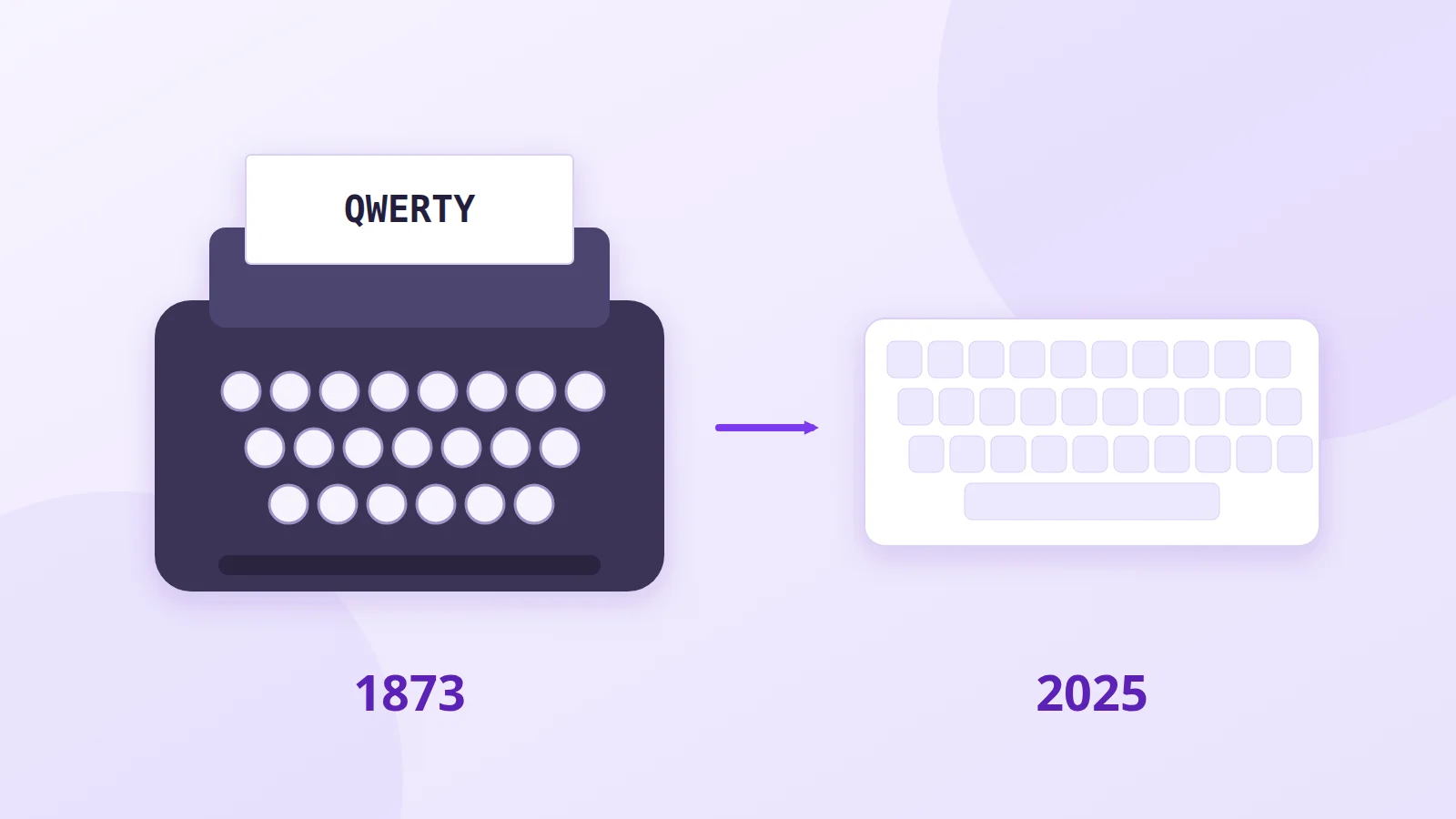
Give or take a few keys, the keyboard you're typing on still has the layout of an 1870s typewriter. Here's how that happened.
The first machines (1714-1860)
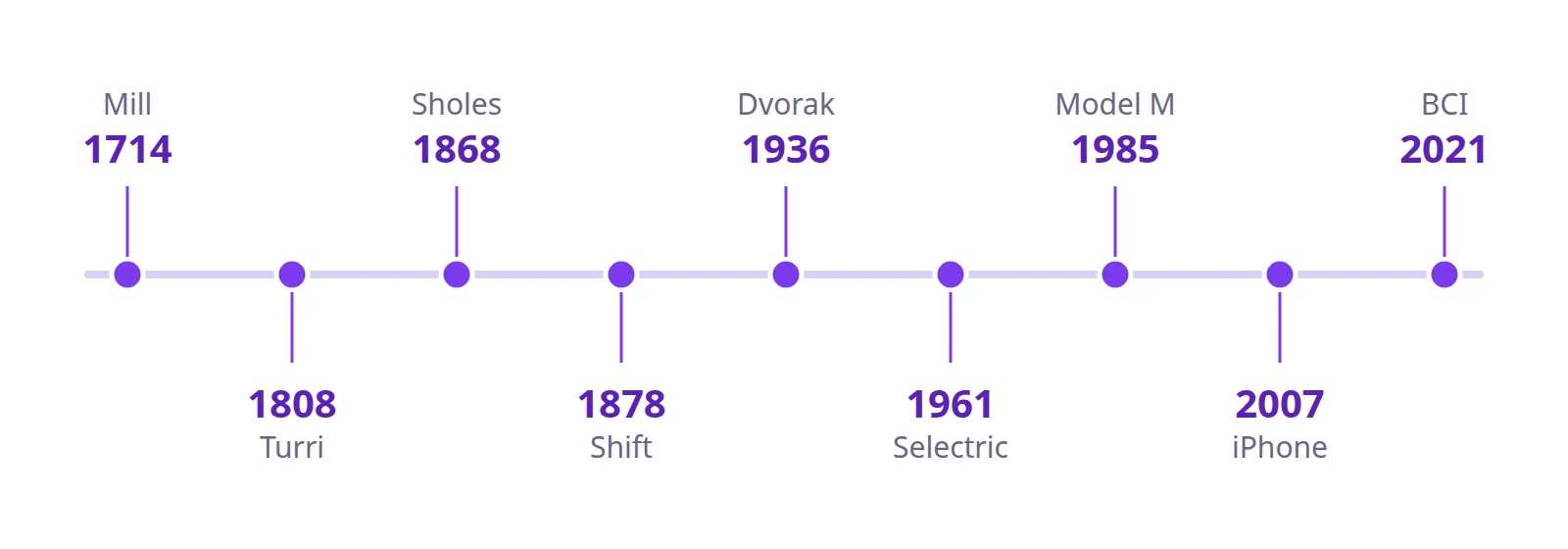
The idea of a machine that writes letters one at a time is old. In 1714, the Englishman Henry Mill patented an "artificial machine" for printing letters. Nobody knows whether it was ever built: no trace of it survives.
Around 1808, the Italian Pellegrino Turri built a machine for his friend, Countess Carolina Fantoni da Fivizzano, who had lost her sight, so that she could write without seeing the page. Several of her typed letters still exist. Turri is often credited with inventing carbon paper, which served as the ink for his machine.
In 1829, the American William Austin Burt patented the "Typographer", a wooden machine where you picked each letter by turning a dial. It was slower than handwriting and never went on sale.
Sholes and the birth of QWERTY (1868-1878)
In the 1860s in Milwaukee, the printer Christopher Latham Sholes worked on a typewriter with Carlos Glidden and Samuel Soule. Their patent dates from 1868. The first model had its keys in alphabetical order, in two rows, like a small piano.
The layout changed several times over the following years, until around 1873 it looked like today's QWERTY. The usual explanation is mechanical: on these machines the bars carrying the letters jammed when two neighbouring letters were struck quickly, so Sholes is said to have separated common English letter pairs. It's a plausible story, but a disputed one: some historians think the layout was shaped mainly by the needs of telegraph operators, who were among the first big users of these machines.
Sholes sold his rights to the gun maker Remington. The Remington No. 1 came out in 1874; it only typed capital letters and sold poorly. The Remington No. 2, in 1878, added the Shift key, which moved the carriage to switch between lower and upper case. That's the machine that made QWERTY stick.
Why QWERTY won
From the 1880s, typing schools taught touch typing on QWERTY. Rival layouts existed, such as the Blickensderfer's, but companies bought the machines their typists knew, and typists learned the layout companies used. Once that loop was in place, nobody had a reason to switch. Economists call this path dependence.
Other countries adapted QWERTY to their own language rather than replacing it: AZERTY in France and Belgium, QWERTZ in Germany and Central Europe.
In 1936, Professor August Dvorak proposed a layout designed for English: vowels under the left hand, the most common consonants under the right, and most keystrokes on the middle row. Its supporters say it's faster and less tiring; the studies showing this are old and disputed. It has never spread beyond enthusiasts.
The electric era (1930-1980)
In 1961, IBM launched the Selectric. The typebars were gone: every character was moulded onto a small ball that pivoted and struck the ribbon. You could change typeface by swapping the ball, and jams became impossible. For twenty years it was the standard office typewriter.
With computer terminals, the keyboard was no longer just for writing but for giving a machine commands. It gained new keys:
- Esc, introduced in the early 1960s to send special commands to terminals;
- Ctrl, inherited from teleprinters, which sends control characters such as line feed;
- arrow keys, to move the cursor before the mouse existed. On some terminals they were printed on the H, J, K and L keys, which is where the vi editor's shortcuts come from.
The PC keyboard (1985)
In 1985, IBM introduced the Model M. Its buckling-spring keys make a loud, crisp click, and it has a reputation for being almost indestructible: many are still in use. Above all, it set the "101-key" layout found on most keyboards today: function keys along the top, arrow keys in an inverted T, a numeric keypad on the right.
Phones and touchscreens (2000 to today)
In the early 2000s, the BlackBerry showed that you could type quickly with your thumbs on a tiny physical keyboard.
In 2007, the iPhone replaced it with a keyboard drawn on the screen. To make up for having no keys to feel, the software corrects typos and quietly enlarges the target for the most likely letters: after "H", it's easier to hit "E" than "Z".
Then came swipe typing, popularised by Swype around 2010: you slide your finger from letter to letter without lifting it, and the software recognises the word from its shape. One of its creators was Cliff Kushler, who had already co-invented T9 for old keypad phones.
What's next?
Voice dictation has become reliable, and we speak faster than we type. But it doesn't suit public places, code or editing.
Brain-computer interfaces are progressing too. In 2021, Stanford researchers enabled a paralysed man to write about 90 characters a minute by imagining he was writing by hand. These implants are still limited to medical research.
The keyboard, meanwhile, is still here, with a layout inherited from Remington's machines. The virtual keyboard is its latest form: the same screen can show Arabic, Russian or Japanese, with no change of hardware.
Further reading
- QWERTY, AZERTY, Dvorak: the layout wars
- Mechanical keyboards: why developers love them
- The future of text input
- Smithsonian Magazine: the legend of the QWERTY keyboard
- Christopher Latham Sholes (Wikipedia)