
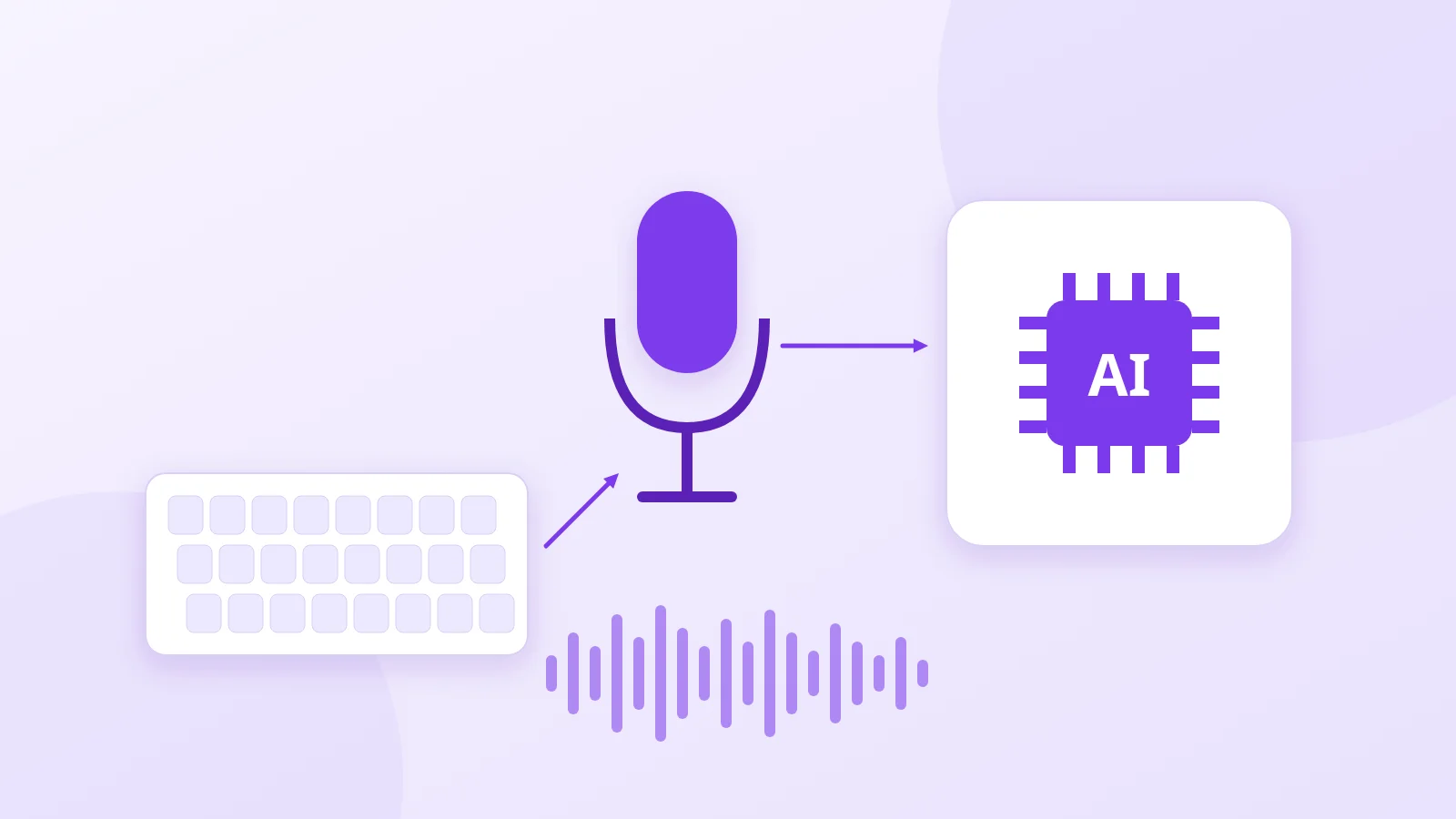
For 150 years, writing on a machine has meant pressing one key per letter. Several technologies are trying to change that. Some are already in our phones; others are still in the lab. Here's where each one stands.
AI that writes with you
This is the most visible change. Phone keyboards have long suggested the next word; recent tools, such as Gmail or the assistants built into word processors, suggest whole sentences or even a complete message.
The idea: you say what you want to get across ("politely decline the wedding invitation") and the tool writes a draft that you edit. The keyboard is then used less for typing text than for giving instructions and proofreading.
The limit is well known: the result is often generic and needs checking. For a personal message or a precise document, you're still better off writing it yourself.
Voice dictation
Speech recognition has become reliable in most languages, accents included. We speak at around 150 words a minute, far faster than we type.
Yet two flaws keep it from replacing the keyboard: you don't dictate a private message on the train, and fixing one word in the middle of a sentence is still easier with a keyboard. It's also a poor fit for code.
MIT researchers have explored a way around the first problem: the AlterEgo prototype uses electrodes on the face and neck to pick up the muscle signals produced when you form words without saying them out loud. It's still a research project.
Typing in virtual reality
With headsets such as Meta Quest or Apple Vision Pro, you type on a keyboard floating in mid-air. It's tiring for the arms and imprecise, since you can't feel the keys. In practice, many users connect a real keyboard or use dictation.
Two approaches aim to do better:
- hand tracking, which lets you type on a bare table while the headset's cameras work out which keys you meant;
- electromyography (EMG) wristbands, developed by Meta in particular after it bought the start-up CTRL-labs. Worn on the wrist, they pick up the electrical signals of the forearm muscles and can recognise very small gestures, or letters traced with a finger.
Brain-computer interfaces
Companies such as Neuralink, Synchron and Blackrock Neurotech, along with university teams, implant electrodes in the motor cortex of paralysed people.
The results are real:
- in 2021 at Stanford, a paralysed man wrote about 90 characters a minute by imagining he was writing by hand;
- in 2023, other teams enabled patients to "speak" through a computer at more than 60 words a minute.
These implants require surgery and are limited to medical trials. Non-invasive versions, such as EEG headsets, are far less precise and can't yet produce text at a useful speed.
And the keyboard?
It isn't going away. It's fast, precise and silent, it works anywhere, and it needs neither a connection nor a microphone. New technologies tend to add to it rather than replace it: you dictate a draft, AI rephrases it, you fix it on the keyboard.
One thing has already changed: the keyboard no longer has to be physical. A virtual keyboard can show any language on any screen, something unthinkable in the typewriter era.
Further reading
- The history of the keyboard
- Stenotype: typing at the speed of speech
- ASCII and Unicode
- MIT Media Lab: the AlterEgo project
- Neuralink