

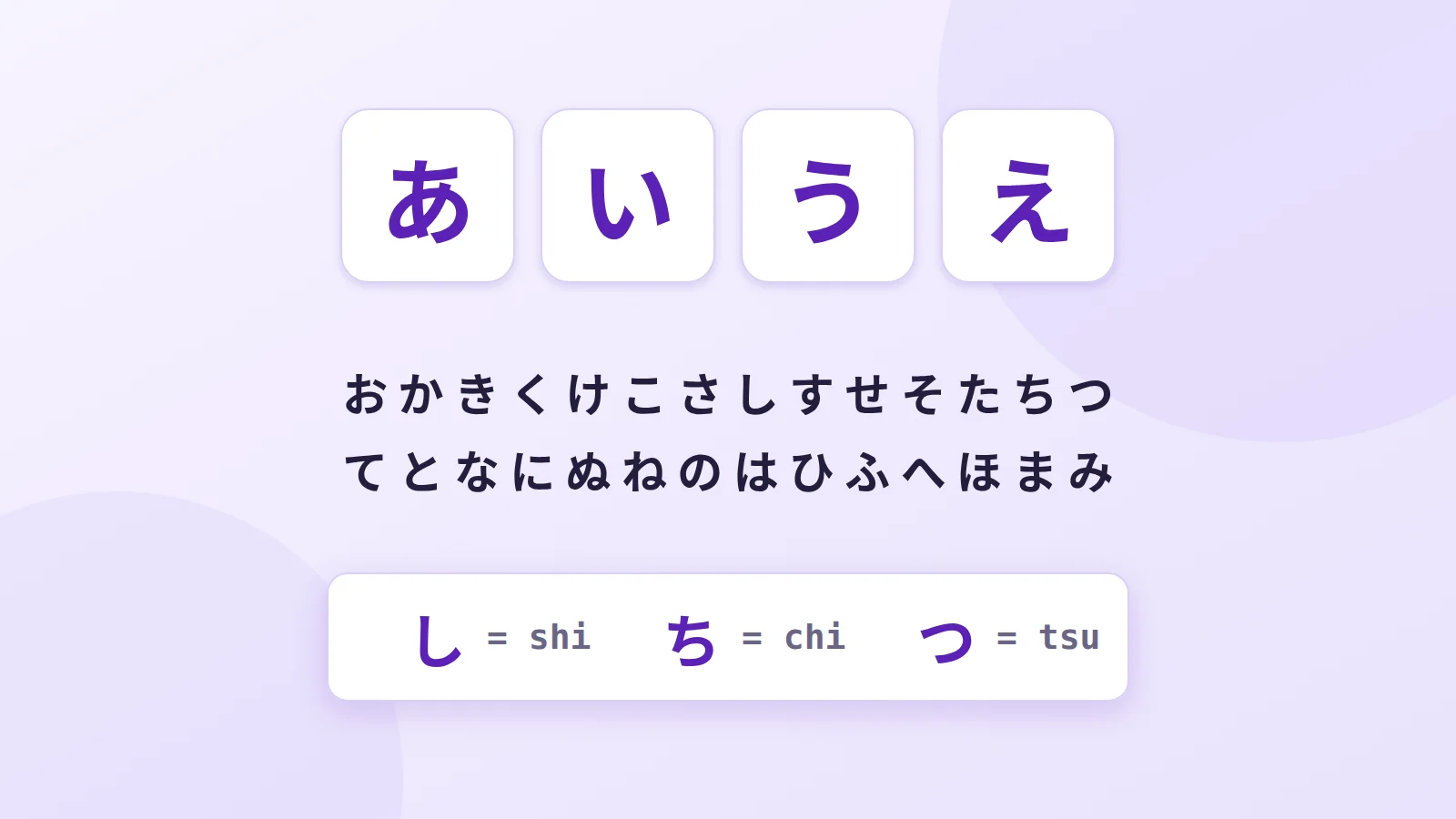
What hiragana is used for
Japanese is written with three scripts at once. Kanji, borrowed from Chinese, carry meaning: 食 in 食べる (taberu, to eat). Hiragana handles everything else: verb and adjective endings (the べる in 食べる), the particles that mark each word's role (は, を, に, で), and words that have no common kanji, such as ありがとう (arigatō). It's also used as furigana, the small reading aids printed above kanji in children's books, manga and textbooks. Katakana, the second syllabary, writes the same sounds but is mostly reserved for loanwords like コーヒー (kōhī); its chart works exactly like this one.
Each hiragana stands for a syllable, not a single letter. The gojūon ("fifty sounds") table is read by row and column: the column gives the vowel (a, i, u, e, o), the row gives the consonant, so か is k + a. The empty cells are syllables that no longer exist in modern Japanese (yi, ye, wi, wu, we). を is romanized wo to tell it apart from お, but it is pronounced o. ん is the only standalone consonant, and it sounds like m before b, p and m (さんぽ, sanpo, a walk).
Reading the romaji correctly
Hepburn romanization uses English consonants, but the vowels are pure and short, closer to Spanish or Italian than to English:
- a as in "father", i as in "machine", e as in "bed", o as in "port" but shorter.
- u is short and unrounded, with relaxed lips; it often almost disappears after s and before t (です, desu, sounds like "dess").
- r is a single tap of the tongue, somewhere between r, l and the d in "ladder".
- g is always hard (ぎ, gi, as in "gift"), ts (つ) is the sound at the end of "cats", and fu (ふ) is blown softly through both lips, not with the teeth.
Small っ, long vowels and combined sounds
The two strokes ゛ (dakuten) voice the consonant: か ka becomes が ga, さ sa becomes ざ za. The small circle ゜ (handakuten) turns the h row into p: は ha becomes ぱ pa. ぢ and づ sound the same as じ and ず; they appear in only a few words (はなぢ, hanaji, nosebleed; つづく, tsuzuku, to continue).
A small ゃ, ゅ or ょ after an i-row syllable merges into one syllable: き + ゃ = きゃ (kya), し + ょ = しょ (sho). Written full size, きや is two beats, ki-ya. In the same way, a small っ doubles the next consonant (きって, kitte, stamp).
Long vowels last two beats and change meaning: おばさん (obasan, aunt) is not おばあさん (obāsan, grandmother). A long ē is usually written with い (せんせい, sensei) and a long ō with う (がっこう, gakkō).
A practical way to learn and type hiragana
Learn the five vowels first, then the k, s, t, n, h, m, y, r and w rows and ん, reviewing earlier rows every day. Give each shape a personal mnemonic image, write it by hand a few times, then move on to reading real words as soon as possible: recognizing characters inside words is what makes them stick. Dakuten and combinations need no extra memorizing, since they reuse shapes you already know. Watch the look-alike pairs: さ/ち, ぬ/め, ね/れ/わ, る/ろ.
To type, the Japanese keyboard's transliteration mode turns romaji into hiragana as you go: konnichiha becomes こんにちは and gakkou becomes がっこう. Type nn for ん, wo for を, ha for the particle は, and double the consonant to get っ.