

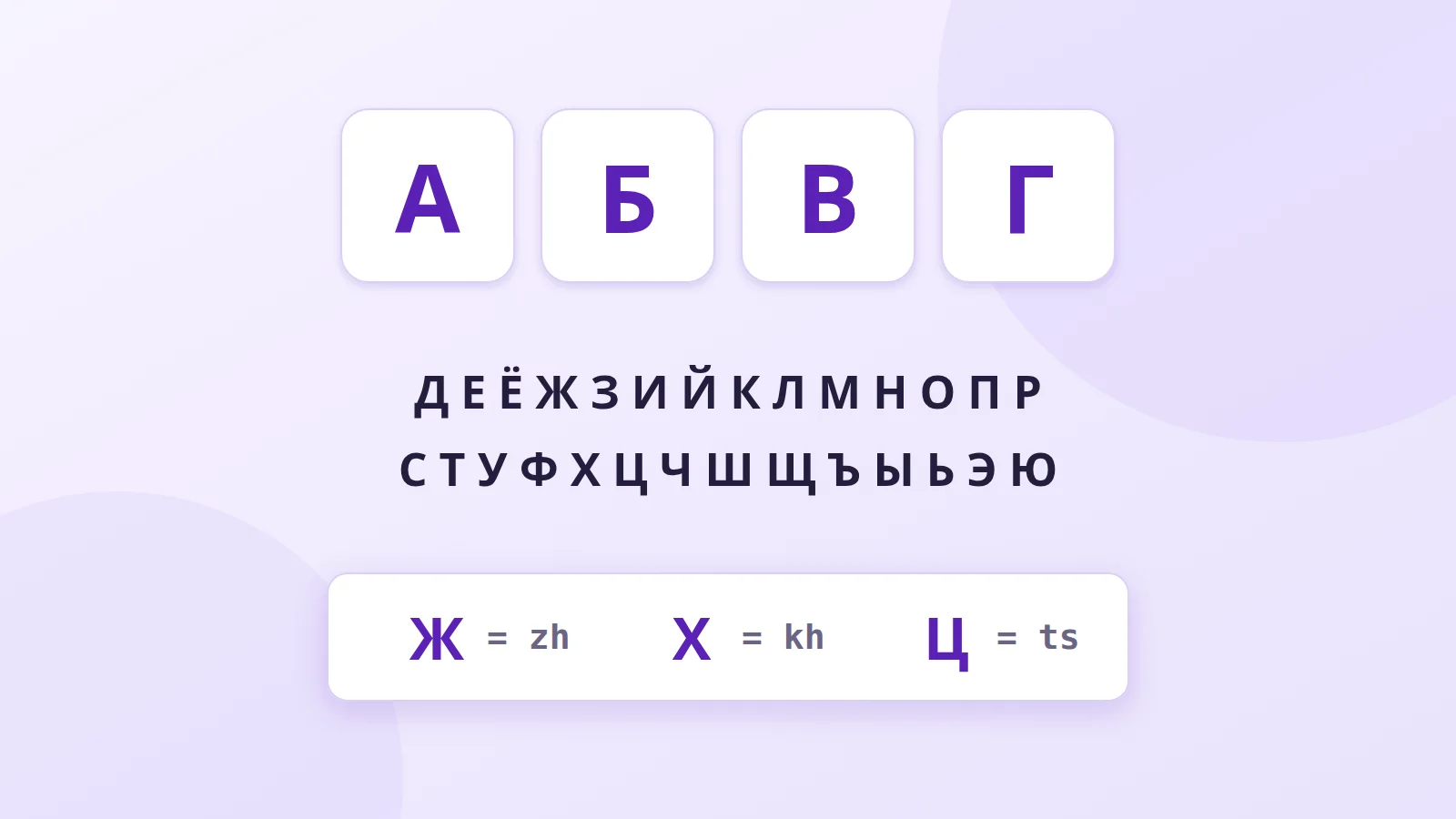
Familiar letters and false friends
An English speaker already knows a few Russian letters. А, К, М, О and Т look and sound roughly as expected. The trouble comes from false friends: letters that look Latin but stand for a different sound.
- В = v (вода, "water")
- Е = ye (есть, "to eat")
- Н = n (нет, "no")
- Р = a rolled r (рыба, "fish")
- С = s (суп, "soup")
- У = oo (улица, "street")
- Х = kh, like the ch in Scottish "loch" (хлеб, "bread")
The remaining letters are new but regular: Б b, Г hard g, Д d, Ж zh (the s in "measure"), З z, И ee, Й a short y, Л l, П p, Ф f, Ц ts, Ч ch, Ш sh, Щ a long soft sh. Ы has no English equivalent: it is an i pronounced with the tongue pulled back. Э is the e in "met". Reading international words such as ресторан, телефон or музей is the quickest way to make the alphabet stick.
Hard and soft: paired vowels and the two signs
Most Russian consonants come in a hard and a soft (palatalized) version, and the spelling marks the difference with the vowel that follows. Vowels come in pairs: а/я, у/ю, о/ё, ы/и, э/е. The second letter of each pair softens the consonant before it; at the start of a word or after another vowel it adds a y sound, so я is ya, ю is yu, ё is yo and е is ye.
The soft sign ь softens a consonant without a vowel: брат ("brother") ends in a hard t, мать ("mother") in a soft one. The hard sign ъ is uncommon and mainly keeps a prefix apart from a y-vowel, as in объявление ("announcement").
Stress, vowel reduction and italic forms
Stress is free and is not written in normal text (textbooks mark it with an acute accent). It matters because unstressed vowels weaken: an unstressed о sounds like a, so молоко ("milk") is said roughly "ma-la-KO". Unstressed е and я move towards a short i. Voiced consonants are devoiced at the end of a word: хлеб is pronounced "khlyep".
In italics and handwriting several lowercase letters change shape: т looks like an m, д like a g, и like a u and п like an n. Learn these early, because signs, menus and handwritten notes use them all the time.
Transliteration
The chart uses BGN/PCGN, which is close to standard English spellings (sh, zh, kh, shch, ya, yu). It is not the only system, so the same name can appear in several forms (Tchaikovsky is an older French-influenced spelling). To write in Cyrillic, click a letter in the chart to copy it, or switch to the site's Russian virtual keyboard to type whole words and sentences.