
A cursive script read from right to left
Arabic is written from right to left, has no capital letters, and joins the letters of a word much like handwriting. Each letter therefore has up to four shapes: isolated, initial, medial and final. The letter ه, for example, becomes هـ at the start of a word, ـهـ in the middle and ـه at the end. This is not 112 separate symbols to memorize: the core shape stays recognizable, and the keyboard picks the right variant for you.
Six letters break the chain: ا د ذ ر ز و connect to the letter before them but never to the one after. They only have isolated and final forms, and the next letter starts again with an initial form. That is why a word like وزير (wazīr, minister) looks split into several pieces. Lām followed by alif always fuses into the ligature لا.
Letter families told apart by dots
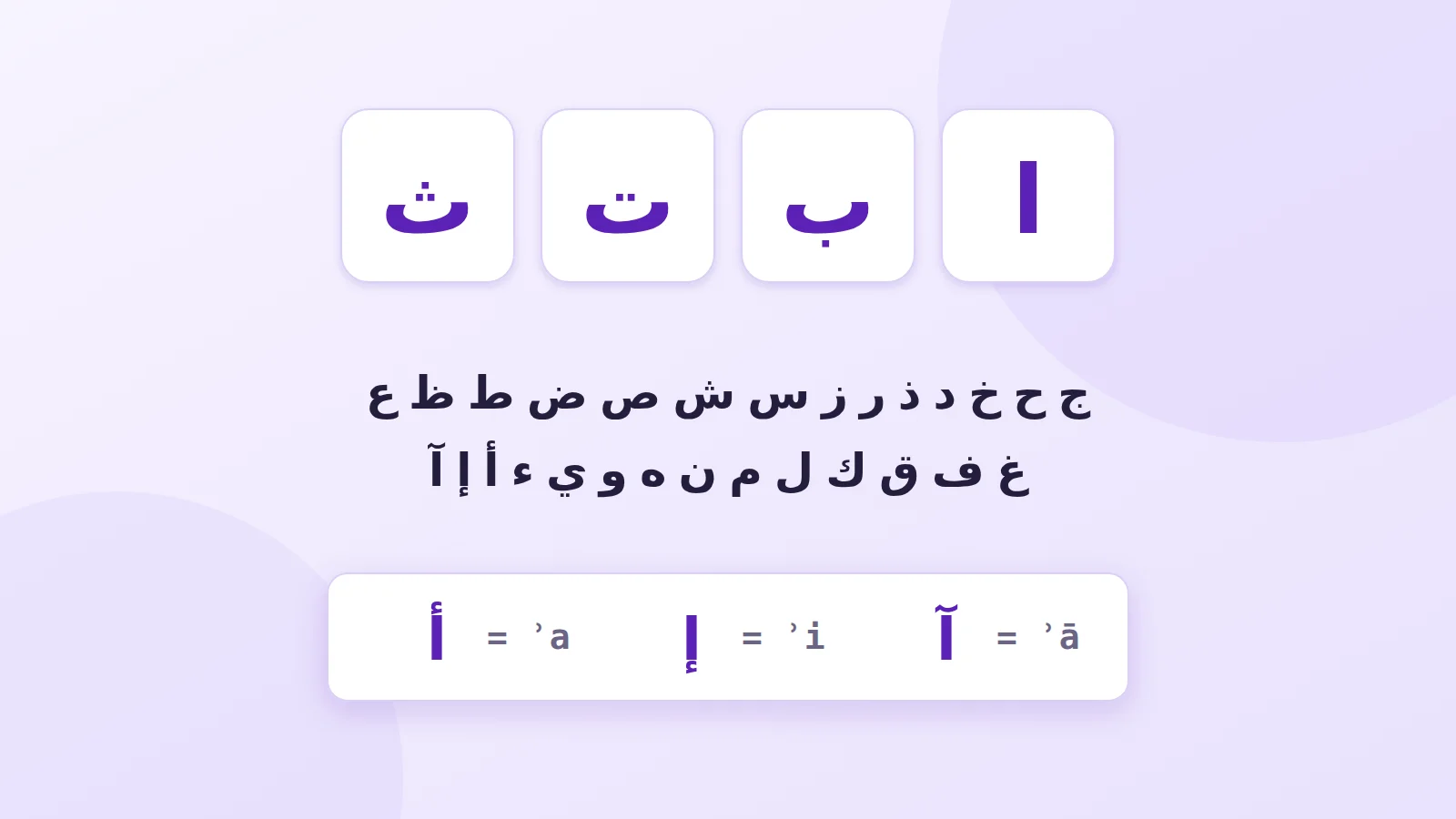
Many letters share one skeleton and differ only in the number and position of their dots: ب ت ث (b, t, ṯ), ج ح خ (ǧ, ḥ, ḫ), د ذ (d, ḏ), ر ز (r, z), س ش (s, š), ص ض (ṣ, ḍ), ط ظ (ṭ, ẓ), ع غ (ʿ, ġ). The traditional order used in the chart keeps these families together. Learning the skeletons first and the dots second is the fastest route: in practice you need about fifteen basic shapes.
Sounds English does not have
A few consonants take practice for English speakers:
- ح (ḥ): a strong breathy h made by tightening the throat, with no scraping.
- ع (ʿ): a voiced squeeze deep in the throat, the most distinctive Arabic sound.
- خ (ḫ): like the ch in Scottish loch or German Bach.
- غ (ġ): a gargled sound close to the French r.
- ق (q): a k pronounced much further back, at the uvula.
- The emphatics ص ض ط ظ: s, d, t and ḏ said with the back of the tongue raised, which darkens the neighbouring vowel.
ث and ذ are the th of think and of this. Pronunciation varies across dialects: ج is often j as in French jour in North Africa and g in Egypt, and ق can become g or a glottal stop.
Missing vowels and Arabizi
The script records consonants and long vowels (ا ā, و ū, ي ī) but almost never short vowels. كتب can be read kataba (he wrote) or kutub (books), and context decides. The marks in the third chart (fatḥa, kasra, ḍamma, sukūn, šadda, tanwīn) are only used in the Quran, learning materials and children's books, or to remove an ambiguity.
To write Arabic on a Latin keyboard, many people use Arabizi, in which digits stand for sounds the Latin alphabet lacks: 3 for ع, 7 for ح, 5 for خ, 2 for ء, and in the Maghreb 9 for ق (in the Levant and the Gulf, 9 usually stands for ص). The phonetic mode of the Arabic virtual keyboard follows these conventions, so you can type whole words in Arabic from a standard keyboard.