
A script designed by a king
Hangul was created in 1443 under King Sejong of the Joseon dynasty and published in 1446 in the Hunminjeongeum, “the correct sounds for instructing the people”. Until then Koreans wrote in Chinese characters, which only an educated elite could master. Sejong's stated aim was to let ordinary people write their own language. South Korea celebrates Hangul Day on 9 October.
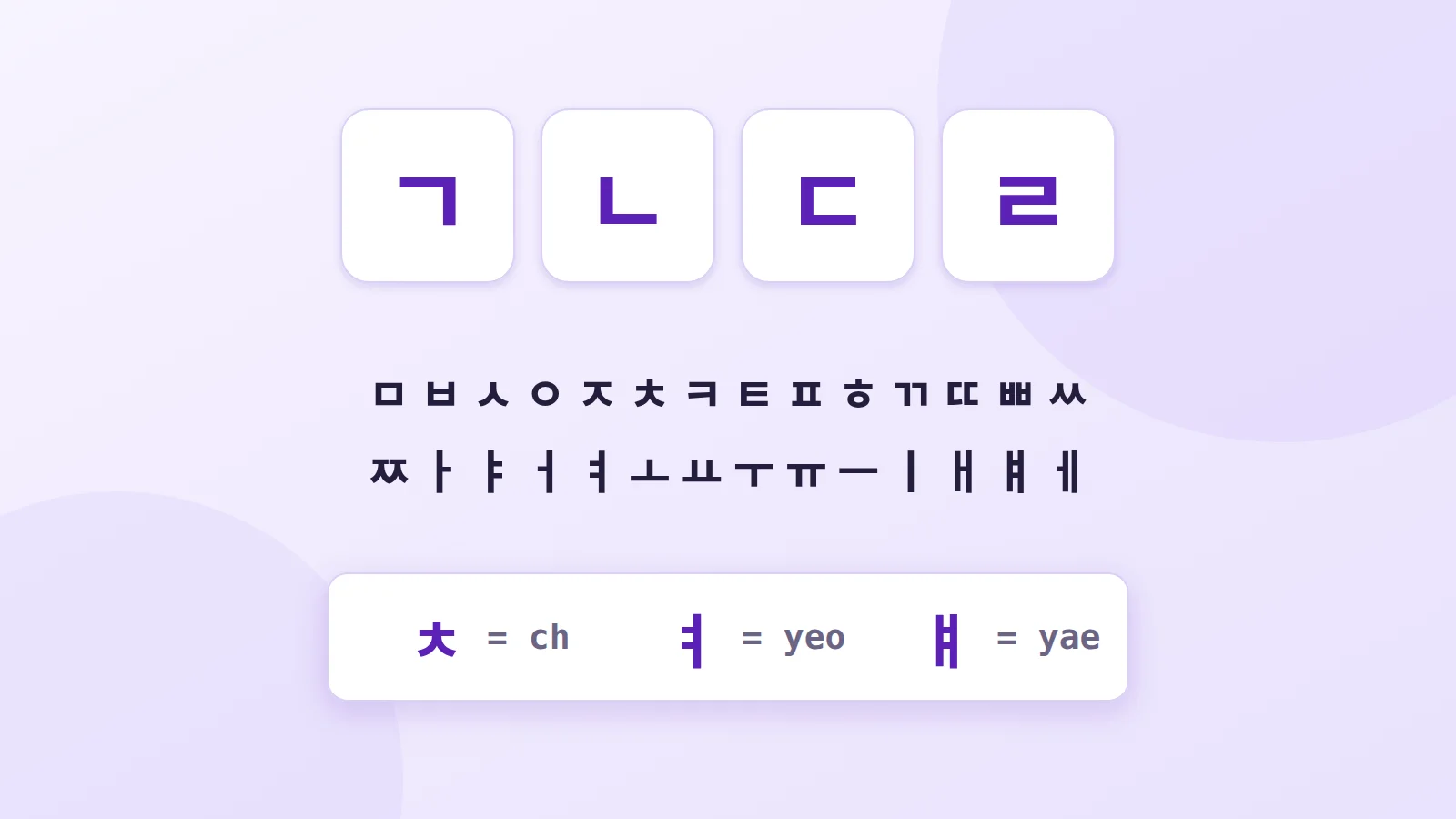
The letter shapes are not arbitrary. The basic consonants picture the speech organs: ㄱ shows the back of the tongue closing the throat, ㄴ the tongue touching the gum ridge, ㅁ the closed mouth, ㅅ a tooth and ㅇ the throat. Other consonants add a stroke: ㄱ becomes ㅋ (aspirated), ㄴ becomes ㄷ and then ㅌ. Vowels combine three elements: a dot for heaven, a horizontal line for earth (ㅡ) and a vertical line for humans (ㅣ). The dot later became a short stroke, giving ㅏ, ㅓ, ㅗ and ㅜ.
How letters stack into syllable blocks
Korean is not written letter by letter along a line. Letters are grouped into square blocks, one per syllable. Each block holds an initial consonant, a vowel and sometimes a final consonant called batchim. Vertical vowels (ㅏ ㅓ ㅣ) sit to the right of the consonant, horizontal ones (ㅗ ㅜ ㅡ) sit below it, and the batchim always goes at the bottom.
- 한 = ㅎ + ㅏ + ㄴ → han
- 글 = ㄱ + ㅡ + ㄹ → geul (한글, hangeul, the name of the script)
- 꽃 = ㄲ + ㅗ + ㅊ → kkot, “flower”: final ㅊ is pronounced t
Only seven sounds exist at the end of a syllable (k, n, t, l, m, p, ng), which is why the chart gives two values for some letters, such as ㅅ “s / t”. The syllable chart above shows every consonant + vowel pair without a batchim; click a cell to copy that syllable, and use the Korean virtual keyboard to type whole words.
Romanization and pronunciation tips
This page uses Revised Romanization, the official system in South Korea since 2000. Some spellings mislead English speakers:
- eo (ㅓ) is a single vowel, close to the “u” in “cup”, not “ee-oh”.
- eu (ㅡ) is like “oo” said with spread, unrounded lips.
- u (ㅜ) is “oo” as in “moon”; o (ㅗ) is a pure “o” without the English glide.
- ae and e (ㅐ ㅔ) are both pronounced like the “e” in “bed” by most speakers today.
- ㄹ is a light flap (like the “tt” in American “butter”) between vowels and an “l” at the end of a syllable.
Plain consonants (g, d, b, j) are almost voiceless at the start of a word and voiced between vowels, so 고기 sounds like “ko-gi”. Aspirated consonants (k, t, p, ch) carry a strong puff of air, stronger than English. Tense consonants (kk, tt, pp, ss, jj) have no puff at all, like the “p” in “spin”, said with a tight throat.
Typing Hangul on a keyboard
The standard layout is Dubeolsik (“two sets”): consonants under the left hand, vowels under the right. You type letters in reading order and the keyboard assembles the blocks for you. When a consonant is followed by a vowel, it moves to the next block automatically: ㅎ ㅏ ㄴ ㅏ gives 하나, not 한ㅏ. Shift produces the double consonants and ㅒ ㅖ. The Korean keyboard on this site works the same way, so you can write Korean without installing a layout on your computer.