
Over two thousand years of writing
Tifinagh descends from the Libyco-Berber script, used across North Africa in antiquity: the Punic–Libyan bilingual inscription of Dougga, in Tunisia, dates from the 2nd century BC. That script recorded consonants only. The Tuareg of the Sahara kept it in continuous use under the name tifinagh, for rock inscriptions, messages and poetry.
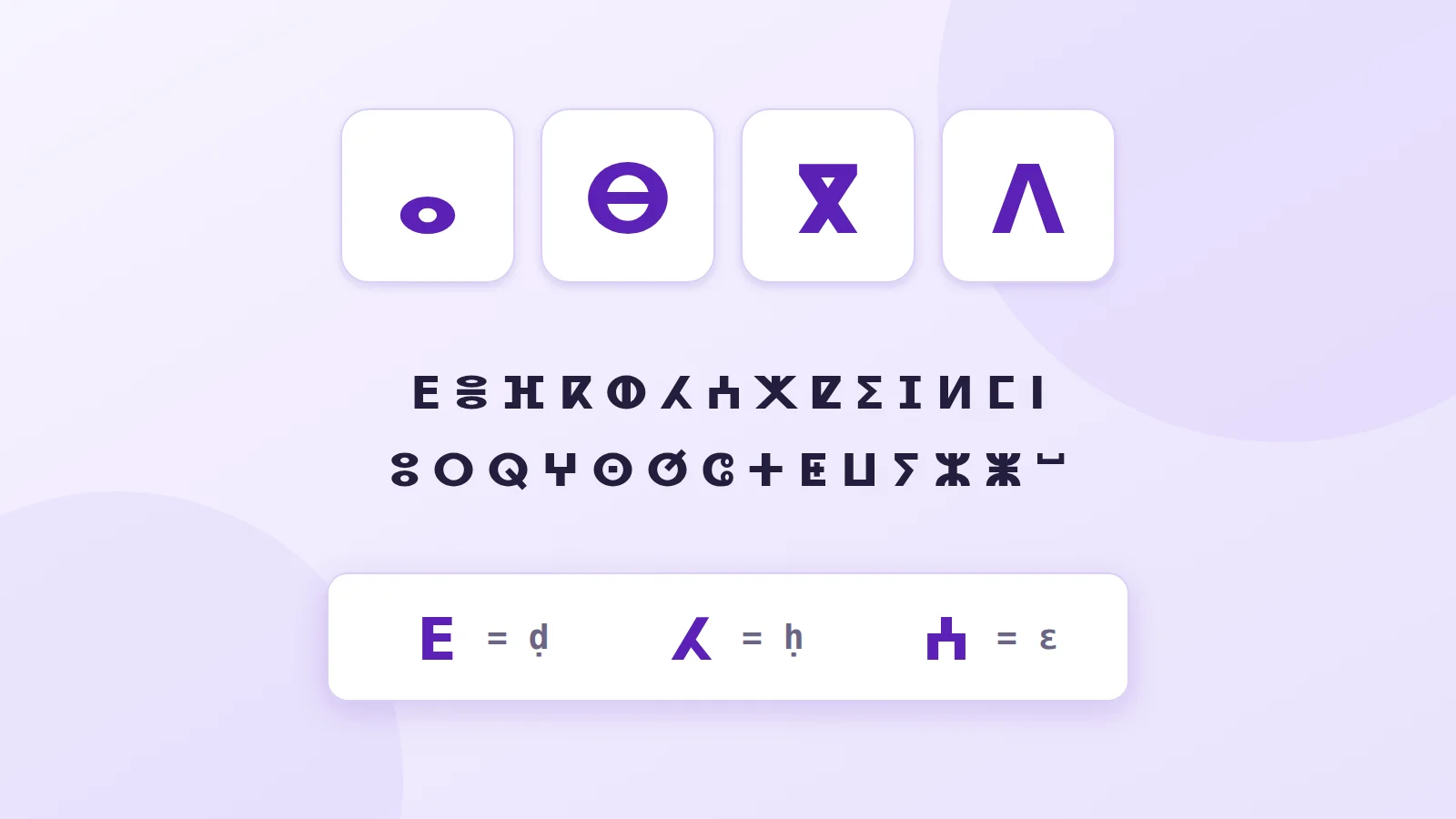
In the 1970s the Berber Academy in Paris developed Neo-Tifinagh, adding vowels so that the northern varieties could be written in full. In Morocco, the Royal Institute of Amazigh Culture (IRCAM), founded in 2001, standardized the alphabet in 2003. That standard, shown on this page, is taught in Moroccan schools and was encoded in Unicode in 2005. Tamazight became an official language of Morocco in the 2011 constitution and of Algeria in the 2016 constitutional revision.
Where you see Tifinagh today
In Morocco, Tifinagh appears on ministries, town halls and schools, on road signs and official documents, next to Arabic and often French. Amazigh textbooks use it from primary school to university. In Algeria it appears on signage and in teaching, although Kabyle is mostly written in the Latin alphabet. Tamazight is therefore read in three scripts: Tifinagh, a Latin alphabet with letters such as ḍ, ṭ, ɣ and ɛ, and the Arabic script, used historically in Tashelhit (Shilha) manuscripts.
Reading the letters as an English speaker
Most letters stand for a single sound, so spelling is regular. Some reference points:
- ⵓ is the "oo" of "food", ⵉ the "ee" of "see", ⵛ is "sh", ⵊ the "s" in "measure", ⵢ the "y" of "yes".
- ⵖ (ɣ) is a throaty r, as in French "Paris"; ⵅ (x) is the "ch" of Scottish "loch".
- ⵔ is a rolled r, ⵙ is always the s of "sun", ⵣ always z.
- ⵃ (ḥ) and ⵄ (ɛ) are the pharyngeal sounds of Arabic ح and ع; ⵇ is a q made further back than k.
- ⴻ is the neutral vowel, like the "a" in "about".
Emphatic and labialized consonants
Tamazight distinguishes "emphatic" consonants, said with the back of the tongue pulled toward the throat, like the emphatics of Arabic. Latin transcription marks them with a dot below: ḍ ⴹ, ṭ ⵟ, ṣ ⵚ, ẓ ⵥ, ṛ ⵕ. The ḥ of ⵃ also carries a dot, but it is a pharyngeal, not an emphatic. In Tifinagh each has its own letter: ⴷ d and ⴹ ḍ are separate letters, and swapping ⵙ for ⵚ can change a word's meaning.
The labialized consonants gʷ and kʷ are pronounced with rounded lips, roughly "gw" and "kw". They are written by adding the mark ⵯ after the letter: ⴳⵯ, ⴽⵯ. You can click these combinations in the chart to copy them directly; to write full sentences, switch to the Amazigh virtual keyboard.