

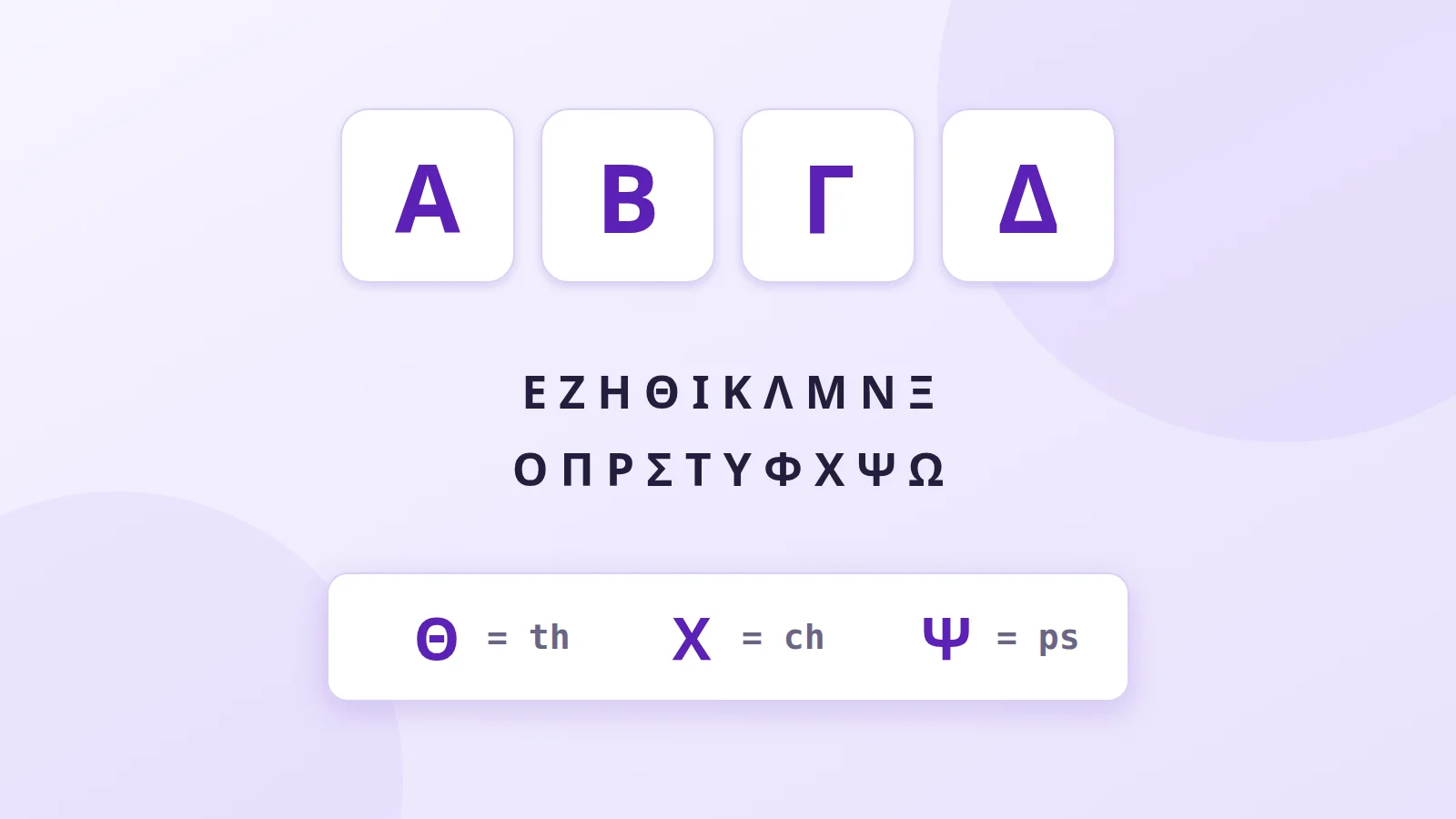
Modern vs Ancient Greek pronunciation
Ancient and Modern Greek use exactly the same 24 letters, but many of them no longer sound the way they did in Plato's Athens. The chart above follows Modern Greek, the language spoken in Greece and Cyprus today.
The biggest change is a process called iotacism: η, ι and υ, along with the pairs ει and οι, have all merged into a single [i] sound. αι is now [e] and ου is [u]. Several consonants softened as well. β is [v], δ is the voiced th of English this, θ is the th of think, and γ is a soft guttural sound that becomes a y sound before e and i. Because β, δ and γ no longer stand for b, d and g, Modern Greek spells those sounds with consonant pairs: μπ, ντ and γκ.
If you study Classics in an English-speaking school or university, you will usually read Ancient Greek with a reconstructed or Erasmian pronunciation: β as b, η as a long e, υ like French u, φ as an aspirated p and χ as an aspirated k (often simplified to f and the ch of Scottish loch). This keeps every letter distinct, which helps with spelling and grammar, even if it does not match Modern Greek speech.
Greek letters in math and science
Many people look up the Greek alphabet for a math or physics course. Some letters to know: π (circle constant), Σ (sum), Π (product), Δ (change or discriminant), δ (a small variation), α, β, θ, φ (angles), λ (wavelength, eigenvalue), μ (mean, the prefix micro-, coefficient of friction), σ (standard deviation), ε (an arbitrarily small number, permittivity), ρ (density), τ (torque, time constant), ω (angular frequency) and Ω (ohm). Watch out for the lookalikes: ν (nu) is not v, ρ (rho) is not p, and χ (chi) is not x.
The two sigmas, accents and punctuation
Sigma is the only letter with two lowercase forms: σ at the start or in the middle of a word, ς at the end, as in σεισμός (earthquake). Greek keyboards have a separate key for the final sigma.
Since 1982, Modern Greek has officially used the monotonic system: a single accent mark, the tonos (ά, έ, ή, ί, ό, ύ, ώ), on the stressed syllable of words with more than one syllable. A diaeresis (ϊ, ϋ) shows that two vowels are pronounced separately. Ancient texts keep the older polytonic system with rough and smooth breathings and acute, grave and circumflex accents.
Where the Greek alphabet came from
The Greeks adapted the Phoenician script around the 8th century BC and added letters for vowels, making it the first alphabet to write vowels and consonants systematically. Several local versions existed; Athens officially adopted the Ionic alphabet in 403 BC, and that version became standard Greek. A western Greek variant, passed on through the Etruscans, became the Latin alphabet you are reading now. In the 9th and 10th centuries, the Cyrillic alphabet was built largely on Greek letters, which is why Г, Д, П and Ф look familiar to anyone who knows Greek.