
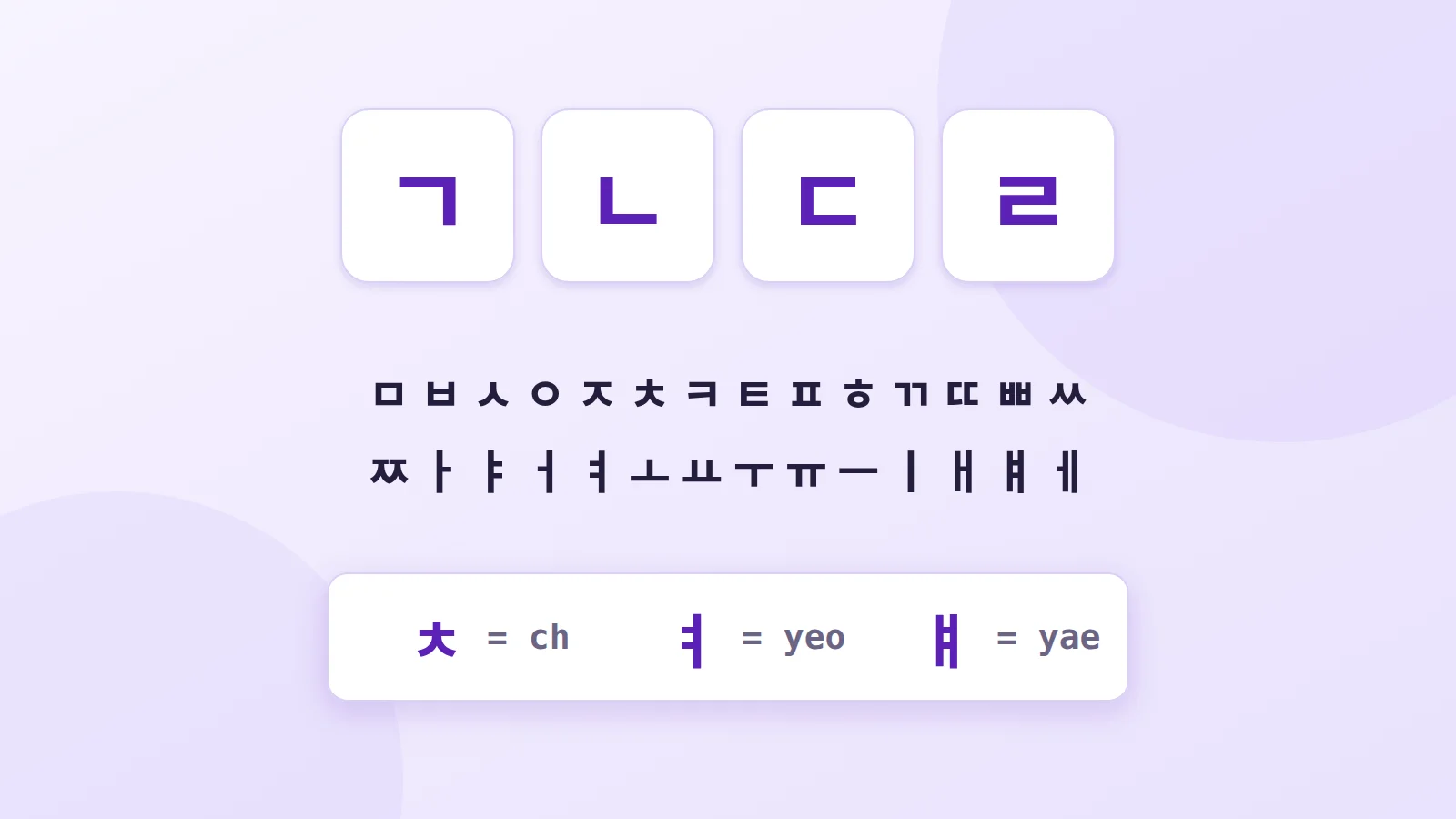
Hangul has 24 basic letters (14 consonants and 10 vowels), plus 5 double consonants and 11 compound vowels. Click any letter or syllable to copy it.

The 14 basic consonants

LetterNameTransliterationPronunciation (IPA)
기역giyeokg / k/k ~ ɡ/
니은nieunn/n/
디귿digeutd / t/t ~ d/
리을rieulr / l/ɾ ~ l/
미음mieumm/m/
비읍bieupb / p/p ~ b/
시옷siots / t/s/
이응ieung— / ng/∅ / ŋ/
지읒jieutj / t/tɕ ~ dʑ/
치읓chieutch / t/tɕʰ/
키읔kieukk/kʰ/
티읕tieutt/tʰ/
피읖pieupp/pʰ/
히읗hieuth / t/h/

The 5 double (tense) consonants

LetterNameTransliterationPronunciation (IPA)
쌍기역ssanggiyeokkk / k/k͈/
쌍디귿ssangdigeuttt/t͈/
쌍비읍ssangbieuppp/p͈/
쌍시옷ssangsiotss / t/s͈/
쌍지읒ssangjieutjj/t͈ɕ/

The 10 basic vowels

LetterNameTransliterationPronunciation (IPA)
아a/a/
야ya/ja/
어eo/ʌ/
여yeo/jʌ/
오o/o/
요yo/jo/
우u/u/
유yu/ju/
으eu/ɯ/
이i/i/

The 11 compound vowels

LetterNameTransliterationPronunciation (IPA)
애ae/ɛ/
얘yae/jɛ/
에e/e/
예ye/je/
와wa/wa/
왜wae/wɛ/
외oe/ø ~ we/
워wo/wʌ/
웨we/we/
위wi/y ~ ɥi/
의ui/ɰi/

Syllable chart: consonant + vowel

ayaeoyeooyouyueui
g
n
d
r
m
b
s
—
j
ch
k
t
p
h

To type whole words, use the Korean Keyboard Online.

A script designed by a king

Hangul was created in 1443 under King Sejong of the Joseon dynasty and published in 1446 in the Hunminjeongeum, “the correct sounds for instructing the people”. Until then Koreans wrote in Chinese characters, which only an educated elite could master. Sejong's stated aim was to let ordinary people write their own language. South Korea celebrates Hangul Day on 9 October.

The letter shapes are not arbitrary. The basic consonants picture the speech organs: ㄱ shows the back of the tongue closing the throat, ㄴ the tongue touching the gum ridge, ㅁ the closed mouth, ㅅ a tooth and ㅇ the throat. Other consonants add a stroke: ㄱ becomes ㅋ (aspirated), ㄴ becomes ㄷ and then ㅌ. Vowels combine three elements: a dot for heaven, a horizontal line for earth (ㅡ) and a vertical line for humans (ㅣ). The dot later became a short stroke, giving ㅏ, ㅓ, ㅗ and ㅜ.

How letters stack into syllable blocks

Korean is not written letter by letter along a line. Letters are grouped into square blocks, one per syllable. Each block holds an initial consonant, a vowel and sometimes a final consonant called batchim. Vertical vowels (ㅏ ㅓ ㅣ) sit to the right of the consonant, horizontal ones (ㅗ ㅜ ㅡ) sit below it, and the batchim always goes at the bottom.

  • 한 = ㅎ + ㅏ + ㄴ → han
  • 글 = ㄱ + ㅡ + ㄹ → geul (한글, hangeul, the name of the script)
  • 꽃 = ㄲ + ㅗ + ㅊ → kkot, “flower”: final ㅊ is pronounced t

Only seven sounds exist at the end of a syllable (k, n, t, l, m, p, ng), which is why the chart gives two values for some letters, such as ㅅ “s / t”. The syllable chart above shows every consonant + vowel pair without a batchim; click a cell to copy that syllable, and use the Korean virtual keyboard to type whole words.

Romanization and pronunciation tips

This page uses Revised Romanization, the official system in South Korea since 2000. Some spellings mislead English speakers:

  • eo (ㅓ) is a single vowel, close to the “u” in “cup”, not “ee-oh”.
  • eu (ㅡ) is like “oo” said with spread, unrounded lips.
  • u (ㅜ) is “oo” as in “moon”; o (ㅗ) is a pure “o” without the English glide.
  • ae and e (ㅐ ㅔ) are both pronounced like the “e” in “bed” by most speakers today.
  • ㄹ is a light flap (like the “tt” in American “butter”) between vowels and an “l” at the end of a syllable.

Plain consonants (g, d, b, j) are almost voiceless at the start of a word and voiced between vowels, so 고기 sounds like “ko-gi”. Aspirated consonants (k, t, p, ch) carry a strong puff of air, stronger than English. Tense consonants (kk, tt, pp, ss, jj) have no puff at all, like the “p” in “spin”, said with a tight throat.

Typing Hangul on a keyboard

The standard layout is Dubeolsik (“two sets”): consonants under the left hand, vowels under the right. You type letters in reading order and the keyboard assembles the blocks for you. When a consonant is followed by a vowel, it moves to the next block automatically: ㅎ ㅏ ㄴ ㅏ gives 하나, not 한ㅏ. Shift produces the double consonants and ㅒ ㅖ. The Korean keyboard on this site works the same way, so you can write Korean without installing a layout on your computer.

Frequently Asked Questions

How many letters are in the Korean alphabet?

24 basic letters: 14 consonants and 10 vowels. Counting the 5 double consonants (ㄲ ㄸ ㅃ ㅆ ㅉ) and the 11 compound vowels (ㅐ ㅔ ㅘ…), there are 40. The original 1443 system had 28 letters, 4 of which are no longer used.

Can you learn Hangul in a day?

Learning to sound out Hangul in a day is realistic: there are few letters and syllable blocks follow strict rules. A 1446 text even claims a wise person can learn it in a morning. Reading fluently and pronouncing well takes a few weeks of practice.

How do you pronounce “eo” in Korean?

ㅓ (eo) is one sound, not “ee-oh”. It is close to the vowel in British “hot” or American “cup”, said with relaxed, unrounded lips. That is why 서울 (Seoul) has two syllables: roughly “suh-ool”.

What is the difference between ㄱ, ㅋ and ㄲ?

They form three series. ㄱ is plain (a light k that sounds like g between vowels), ㅋ is aspirated (k with a strong puff of air) and ㄲ is tense (k with no air and a tightened throat). The same pattern applies to ㄷ ㅌ ㄸ, ㅂ ㅍ ㅃ, ㅈ ㅊ ㅉ and ㅅ ㅆ.

Why is ㅇ silent at the start of a syllable?

Every written syllable must begin with a consonant. When it starts with a vowel sound, ㅇ fills the slot silently: 아 = a, 오 = o. At the end of a syllable, ㅇ is pronounced “ng”, as in 강 (gang, river).

How do I type Korean on an English keyboard?

Use the site's Korean virtual keyboard. It follows the standard 2-set (Dubeolsik) layout, with consonants on the left and vowels on the right, and builds syllable blocks automatically. Typing ㅎ ㅏ ㄴ ㄱ ㅡ ㄹ (keys G K S R M F) gives 한글.

Is Korean written with Chinese characters?

No. Hangul is an alphabet in which each letter stands for a sound. Chinese characters (hanja) are still taught and occasionally used in South Korea, but everyday Korean is written entirely in Hangul.

Other alphabets

Abdelmounaim Akadid

Abdelmounaim Akadid

Passionate about technology, web development and languages. Creator of ClavierVirtuel.com, a tool built to make multilingual typing easy for everyone.

LinkedIn