

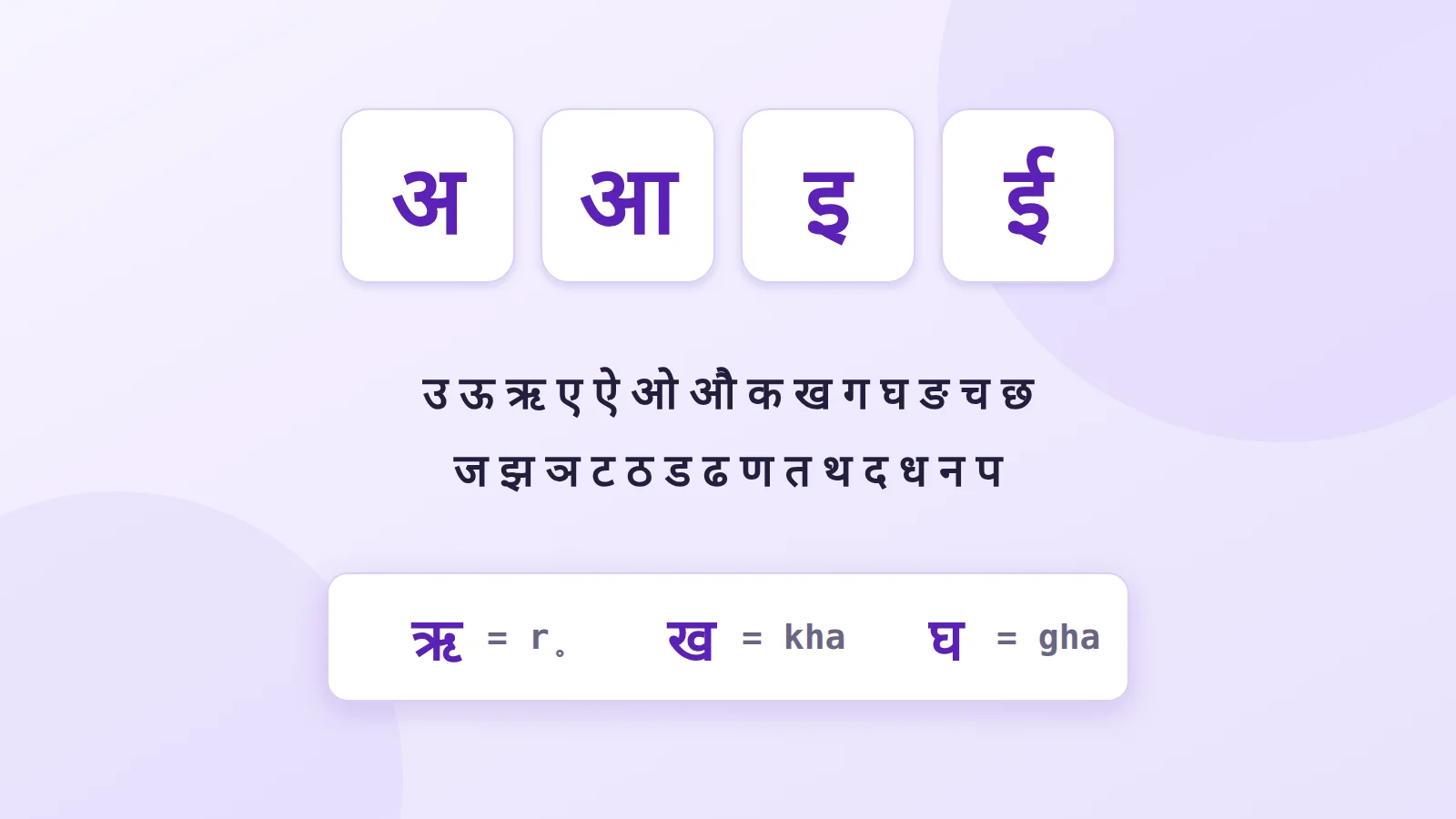
An abugida: each consonant carries a vowel
Devanagari does not write one sound per letter the way the Latin alphabet does. Every consonant includes a short a (pronounced [ə], like the a in "about"): क reads ka, म reads ma. This type of script is called an abugida. The full vowel letters in the chart are used only at the start of a word or after another vowel (आम ām, "mango"). Everywhere else a vowel is written as a matra, a sign attached to the consonant: का kā, की kī, कु ku, के ke, को ko.
Matras sit all around the letter: to the right (ा, ी), below (ु, ू) and above (े, ै). The one that trips up learners is short i, ि, written before the consonant but pronounced after it: कि is ki, हिंदी is hindī. Nearly every letter hangs from a horizontal line, the shirorekha, which runs unbroken across a whole word. There are no capital letters.
Virama, conjuncts and the silent a
To write a consonant with no vowel, add the virama (also called halant) ्: क् is plain k. Inside words, two consonants without a vowel between them usually merge into a conjunct. The first often loses its vertical stroke (स्त in नमस्ते), and र becomes a small hook above the next letter (र्म in धर्म) or a slanted stroke below the previous one (प्र in प्रेम). Four conjuncts are so common that they are taught as letters: क्ष kṣa, त्र tra, ज्ञ (said gya in Hindi, as in ज्ञान gyān) and श्र śra.
Spoken Hindi also drops many inherent vowels, a rule called schwa deletion. कमल is spelled ka-ma-la but said kamal; समझना is said samajhnā, not samajhanā. The final a is almost always silent, and a middle one often is. This is why reading letter by letter gives the wrong pronunciation, and why the romanization Hindi speakers use (kamal, Ram) differs from strict transliteration.
Sounds English speakers miss
Consonants are ordered by where they are made in the mouth, from throat to lips: velar, palatal, retroflex, dental and labial, followed by semivowels and sibilants. Each row of five runs voiceless, voiceless aspirated, voiced, voiced aspirated, nasal. Two contrasts change the meaning of words:
- Aspirated or not: काल kāl ("time") and खाल khāl ("skin") differ only by the breath after k. English aspirates some consonants automatically, but never contrasts them, and the voiced aspirates घ, झ, ढ, ध, भ have no English equivalent at all.
- Retroflex or dental: for ट and ड the tongue tip curls back toward the roof of the mouth; for त and द it touches the upper teeth. English t and d fall in between, which is why Hindi speakers hear them as ट and ड.
Letters with a dot below, the nukta, mark sounds borrowed from Persian, Arabic and English: ज़ z, फ़ f, क़ q. ड़ and ढ़ are retroflex flaps, as in सड़क saṛak ("road").
One script, several languages
The same script is used for Marathi, Nepali and Sanskrit, as well as Konkani and Maithili. The rules differ: Sanskrit pronounces every inherent a, and Marathi adds the letter ळ. Devanagari digits (०–९) are still printed in books and newspapers, though international numerals are standard in official use. Click a character in the chart to copy it, or switch to the Hindi virtual keyboard to type whole words and sentences.