

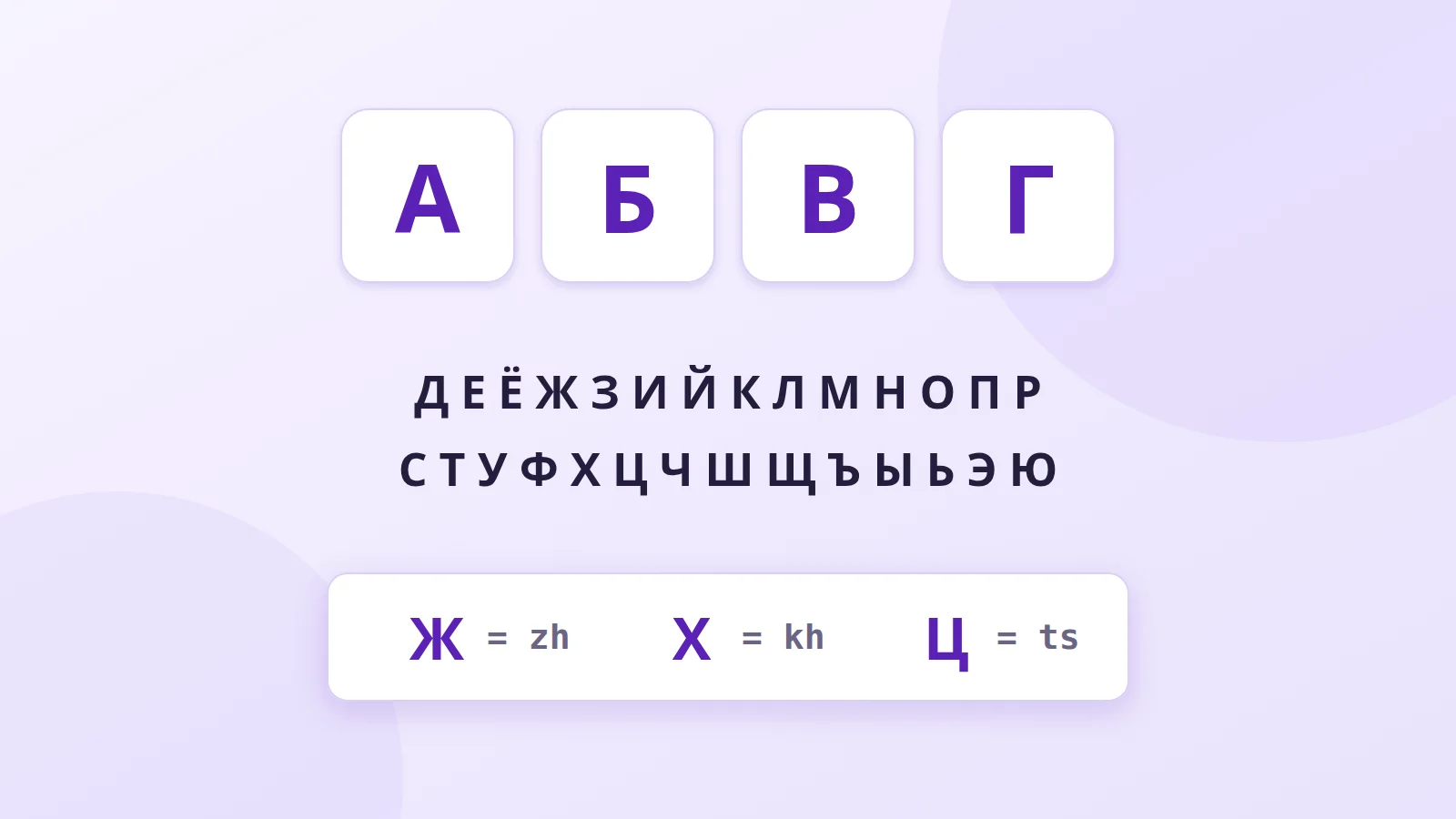
The Russian alphabet has 33 Cyrillic letters: 10 vowels, 21 consonants and 2 signs that have no sound of their own. Click any letter in the chart to copy it.

The 33 letters of the Russian alphabet

LetterNameTransliterationPronunciation (IPA)
аaa/a/
бэbeb/b/
вэvev/v/
гэgeg/ɡ/
дэded/d/
еyee, ye/je/
ёyoë, yë/jo/
жэzhezh/ʐ/
зэzez/z/
иii/i/
и краткоеi kratkoyey/j/
каkak/k/
эльel'l/ɫ/
эмemm/m/
энenn/n/
оoo/o/
пэpep/p/
эрerr/r/
эсess/s/
тэtet/t/
уuu/u/
эфeff/f/
хаkhakh/x/
цэtsets/t͡s/
чеchech/t͡ɕ/
шаshash/ʂ/
щаshchashch/ɕː/
твёрдый знакtvërdyy znak"
ыyy/ɨ/
мягкий знакmyagkiy znak'/ʲ/
эee/ɛ/
юyuyu/ju/
яyaya/ja/

To type whole words, use the Russian Keyboard Online.

Familiar letters and false friends

An English speaker already knows a few Russian letters. А, К, М, О and Т look and sound roughly as expected. The trouble comes from false friends: letters that look Latin but stand for a different sound.

  • В = v (вода, "water")
  • Е = ye (есть, "to eat")
  • Н = n (нет, "no")
  • Р = a rolled r (рыба, "fish")
  • С = s (суп, "soup")
  • У = oo (улица, "street")
  • Х = kh, like the ch in Scottish "loch" (хлеб, "bread")

The remaining letters are new but regular: Б b, Г hard g, Д d, Ж zh (the s in "measure"), З z, И ee, Й a short y, Л l, П p, Ф f, Ц ts, Ч ch, Ш sh, Щ a long soft sh. Ы has no English equivalent: it is an i pronounced with the tongue pulled back. Э is the e in "met". Reading international words such as ресторан, телефон or музей is the quickest way to make the alphabet stick.

Hard and soft: paired vowels and the two signs

Most Russian consonants come in a hard and a soft (palatalized) version, and the spelling marks the difference with the vowel that follows. Vowels come in pairs: а/я, у/ю, о/ё, ы/и, э/е. The second letter of each pair softens the consonant before it; at the start of a word or after another vowel it adds a y sound, so я is ya, ю is yu, ё is yo and е is ye.

The soft sign ь softens a consonant without a vowel: брат ("brother") ends in a hard t, мать ("mother") in a soft one. The hard sign ъ is uncommon and mainly keeps a prefix apart from a y-vowel, as in объявление ("announcement").

Stress, vowel reduction and italic forms

Stress is free and is not written in normal text (textbooks mark it with an acute accent). It matters because unstressed vowels weaken: an unstressed о sounds like a, so молоко ("milk") is said roughly "ma-la-KO". Unstressed е and я move towards a short i. Voiced consonants are devoiced at the end of a word: хлеб is pronounced "khlyep".

In italics and handwriting several lowercase letters change shape: т looks like an m, д like a g, и like a u and п like an n. Learn these early, because signs, menus and handwritten notes use them all the time.

Transliteration

The chart uses BGN/PCGN, which is close to standard English spellings (sh, zh, kh, shch, ya, yu). It is not the only system, so the same name can appear in several forms (Tchaikovsky is an older French-influenced spelling). To write in Cyrillic, click a letter in the chart to copy it, or switch to the site's Russian virtual keyboard to type whole words and sentences.

Frequently Asked Questions

How many letters are in the Russian alphabet?

33: 10 vowels (а, е, ё, и, о, у, ы, э, ю, я), 21 consonants, and 2 signs, the hard sign ъ and the soft sign ь. The signs are not pronounced on their own; they change how the neighbouring letters are read.

How can I learn the Russian alphabet fast?

Learn it in groups rather than in order: first the letters that match English (А, К, М, О, Т), then the false friends (В, Е, Н, Р, С, У, Х), then the new shapes. Practise by reading loanwords such as такси, кафе, метро and компьютер. With 15–20 minutes a day, most learners can read slowly within one or two weeks.

What is the difference between е and ё?

Е is read ye (or e after a consonant, which it softens), ё is read yo and is always stressed. In everyday print ё is usually written as е, so readers must know the word: Горбачёв appears as Горбачев, which is why English has "Gorbachev" rather than "Gorbachyov". Dictionaries and textbooks always mark ё.

What do the hard sign ъ and the soft sign ь do?

The soft sign ь shows that the consonant before it is palatalized (брат "brother" vs мать "mother") and, before a vowel, that a y sound follows (семья, "family"). The hard sign ъ is rare: it separates a prefix from a following е, ё, ю or я, as in подъезд ("entrance").

Why does the Russian Р look like a P?

Cyrillic was built in the 9th–10th centuries mainly from the Greek alphabet, where Ρ (rho) is r. Latin P and Cyrillic Р share that Greek ancestor but kept different sounds. The same history explains В, from Greek beta, which was already pronounced v in medieval Greek.

How do I type in Russian on an English keyboard?

Click a letter in the chart on this page to copy it, or use the site's Russian virtual keyboard, which lets you type whole words and sentences. To type Russian directly on a computer, add the Russian (ЙЦУКЕН) layout in your system language settings.

Which transliteration system should I use for Russian names?

The chart uses BGN/PCGN, the system behind most English spellings (Khrushchev, Zhukov). Academic texts often use the Library of Congress system or ISO 9 (š, ž, č). Russian passports follow their own ICAO-based rules, which give iu, ia and ie for ю, я and ъ.

Other alphabets

Abdelmounaim Akadid

Abdelmounaim Akadid

Passionate about technology, web development and languages. Creator of ClavierVirtuel.com, a tool built to make multilingual typing easy for everyone.

LinkedIn