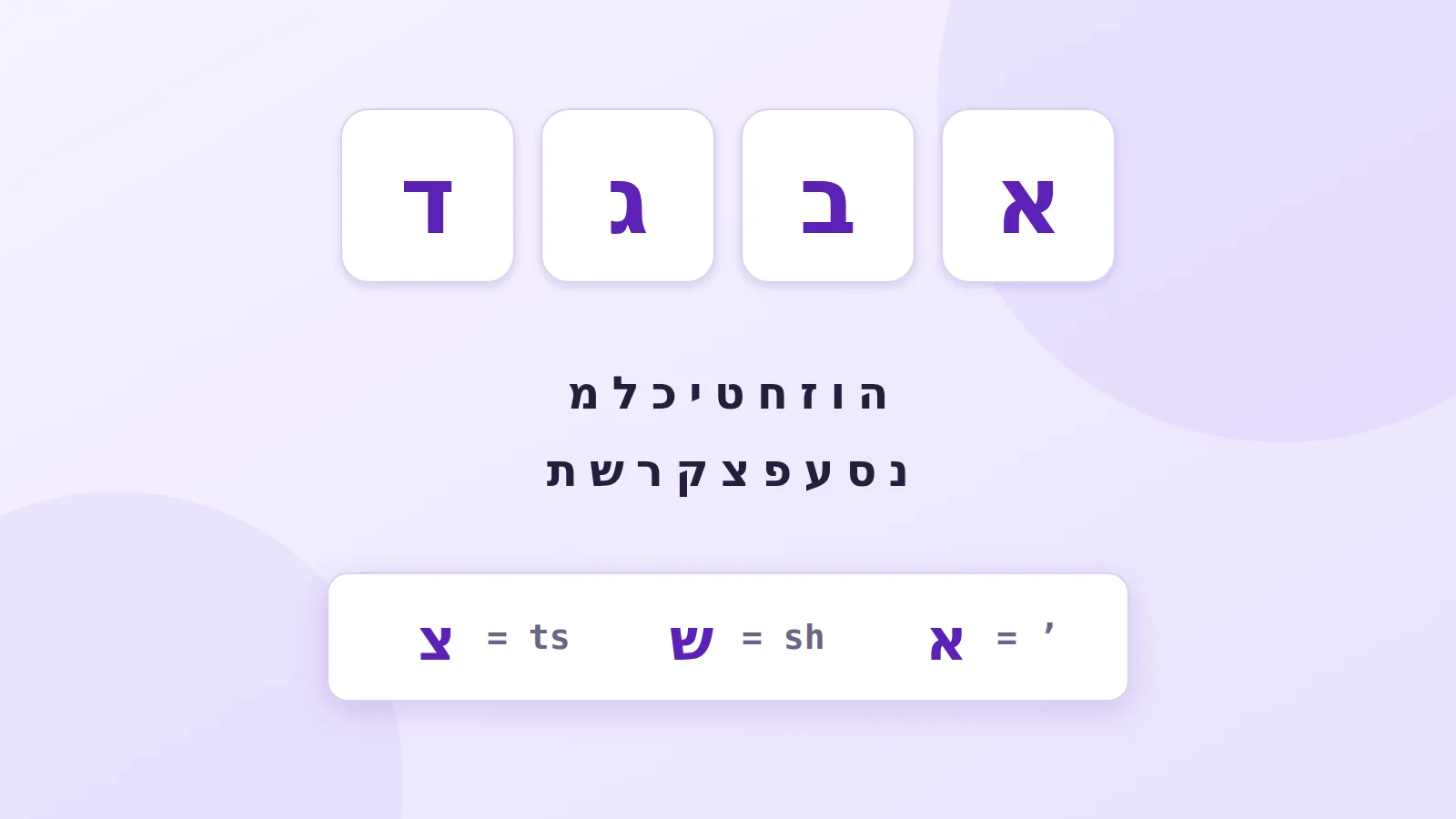
The Hebrew alphabet has 22 letters, all consonants, written from right to left. The chart gives each letter's name, transliteration, Modern Hebrew pronunciation and final form; click any letter to copy it.

The 22 letters of the Hebrew alphabet

LetterNameTransliterationPronunciation (IPA)Final form
אָלֶףalefʼ/ʔ/
בֵּיתbetb / v/b / v/
גִּימֶלgimelg/ɡ/
דָּלֶתdaletd/d/
הֵאheh/h/
וָוvavv/v/
זַיִןzayinz/z/
חֵיתḥetḥ/χ/
טֵיתtett/t/
יוֹדyody/j/
כַּףkafk / kh/k / χ/
לָמֶדlamedl/l/
מֵםmemm/m/
נוּןnunn/n/
סָמֶךְsamekhs/s/
עַיִןayinʻ/ʔ/
פֵּאpep / f/p / f/
צָדִיtsadits/ts/
קוֹףkufk/k/
רֵישׁreshr/ʁ/
שִׁיןshin / sinsh / s/ʃ / s/
תָּוtavt/t/

Hebrew vowel points (niqqud)

LetterNameTransliterationPronunciation (IPA)
פַּתָּחpataḥa/a/
קָמָץqamatsa (o)/a/
סֶגּוֹלsegole/e/
צֵירֵהtseree/e/
חִירִיקḥiriqi/i/
חוֹלָםḥolamo/o/
קֻבּוּץqubbutsu/u/
שׁוּרוּקshuruku/u/
שְׁוָאshvae / –/e / ∅/
דָּגֵשׁdageshb (ב = v)/b/

To type whole words, use the Hebrew Keyboard Online.

A consonant alphabet written right to left

Modern Hebrew uses the square script, which developed from the Aramaic alphabet and is also used for Yiddish and Ladino. Like Arabic, it is an abjad: only consonants are written. The word שלום reads shalom, but nothing in its four letters ש ל ו ם marks the a. Readers rely on vocabulary and context, helped by four letters that double as vowel markers: ו for o or u, י for i or e, and ה or א mostly at the end of a word.

Full vowels are shown with niqqud, a set of dots and dashes placed under, above or inside the letters. The second chart shows them on the letter ב. You need niqqud to learn to read, but Israeli newspapers, websites and street signs almost never use it. In Modern Hebrew, pataḥ and qamats both sound like a, and segol and tsere both sound like e, so the system has more signs than spoken vowels.

The five final letters

Five letters change shape when they end a word: כ becomes ך, מ becomes ם, נ becomes ן, פ becomes ף and צ becomes ץ. Four of these drop below the line; final mem ם is a closed square instead. They are not extra letters: sound and alphabetical position stay the same.

Look-alike letters and letters with two sounds

Several groups are easy to confuse at first:

  • ב and כ: bet has a small tail sticking out at the bottom right; kaf is rounded.
  • ד and ר: dalet has a sharp corner at the top right; resh is curved.
  • ה, ח and ת: he has a gap at the top left, ḥet is closed, tav has a small foot at the bottom left.
  • ו, ז and ן: zayin has a head that sticks out on both sides; final nun descends below the line.
  • ס and ם: samekh is rounded at the bottom; final mem has square corners.

Three letters have two sounds: ב (b or v), כ (k or kh, as in Scottish loch) and פ (p or f). A dot inside the letter, the dagesh, gives the hard sound: בּ is b, ב is v. In unpointed text a useful rule is that at the start of a word they are read b, k and p. Modern Hebrew also merged some sounds: ח and כ without dagesh are pronounced alike, as are ט and ת, ק and כּ, and ו and ב without dagesh. Spelling has to be learned word by word.

Numbers and cursive handwriting

Every letter has a numerical value: א = 1 to י = 10, then כ = 20 up to ק = 100, ר = 200, ש = 300 and ת = 400. These values number chapters and write years in the Hebrew calendar, and they underlie gematria, the interpretation of words through their numerical value. In daily life Israelis write by hand in a cursive script whose shapes differ a lot from print, so learners usually study both. To type whole words on screen, the Hebrew virtual keyboard follows the standard Israeli layout.

Frequently Asked Questions

How many letters are in the Hebrew alphabet?

22. Five of them (כ מ נ פ צ) take a different shape at the end of a word (ך ם ן ף ץ), so there are 27 letter forms in all. Hebrew has no capital or small letters.

Is Hebrew written right to left?

Yes. Letters and words run from right to left, and books open from what an English reader would call the back. Numbers, however, are written left to right.

Does the Hebrew alphabet have vowels?

Not as letters. Hebrew is an abjad: the letters are consonants, and readers supply most vowels from context. The letters א ה ו י sometimes stand for vowels, and a system of dots and dashes called niqqud marks them fully. Niqqud appears in children's books, poetry, the Bible, prayer books and learner material, but rarely in everyday text.

What is the first letter of the Hebrew alphabet?

Alef (א). In Modern Hebrew it is silent or a light glottal stop; the vowel next to it is what you hear. The word alphabet itself goes back, through Greek alpha and beta, to the same Semitic names as alef and bet.

What do the Hebrew letters mean?

The names are old Semitic words. Bet is linked to bayit (house), yod to yad (hand), ayin means eye, resh relates to rosh (head), and alef is usually connected with an ox. Each letter also has a numerical value.

How do I type Hebrew letters?

Click a letter in the chart to copy it, or open the Hebrew virtual keyboard to type whole words without installing anything. On Windows, macOS, iOS and Android you can also add Hebrew as an input language in the keyboard settings.

What is the difference between shin and sin?

They are the same letter, ש. A dot on the upper right (שׁ) gives the sh sound of shin; a dot on the upper left (שׂ) gives the s sound of sin. In unpointed text you have to know the word.

Other alphabets

Abdelmounaim Akadid

Abdelmounaim Akadid

Passionate about technology, web development and languages. Creator of ClavierVirtuel.com, a tool built to make multilingual typing easy for everyone.

LinkedIn